-
I'd Rather Pay $400 Extra for a Guaranteed Date Than Save $400 on a Part That Might Show Up Next Tuesday
-
The Price of 'Probably on Time'
-
Why Morimoto F350 Headlights Are Not Overpriced
-
What Is a Motor Starter? It's a Cost Question
-
Stop Leak Radiator Treatments: A Temporary Answer You Shouldn't Treat as Permanent
-
The P1000 Strut Lesson: A Part Number Is Not a Specification
-
The Counterargument: 'You're Just Paying Brand Tax'
-
When It Makes Sense to Take the Risk
-
The Real Cost of Certainty
I'd Rather Pay $400 Extra for a Guaranteed Date Than Save $400 on a Part That Might Show Up Next Tuesday
That statement usually gets me odd looks from other cost controllers. My job is to watch every line item. I've managed our parts budget ($310,000 annually) for eight years, negotiated with 20+ suppliers, and logged every order in our procurement system. I still believe the cheapest option on paper is often the most expensive one in reality.
The Price of 'Probably on Time'
In March 2024, we ordered 60 sets of Morimoto LED tail lights for a fleet installation window. One supplier quoted $2,400 with estimated delivery. Another quoted $2,650 with guaranteed arrival by the 28th. I chose the cheaper quote because the spreadsheet said so. The shipment arrived April 2. We paid $260 for expedited freight to cover the first install day, and the customer's crew sat idle for two hours while we unpacked. The $250 difference turned into a $600 headache. Not ideal, but workable. But it wasn't the only time.
That experience changed how I evaluate suppliers. Now I ask one question before price: 'Can you commit to a date?' If they can't, the quote is incomplete. I'd rather pay for certainty than budget for maybe.
Why Morimoto F350 Headlights Are Not Overpriced
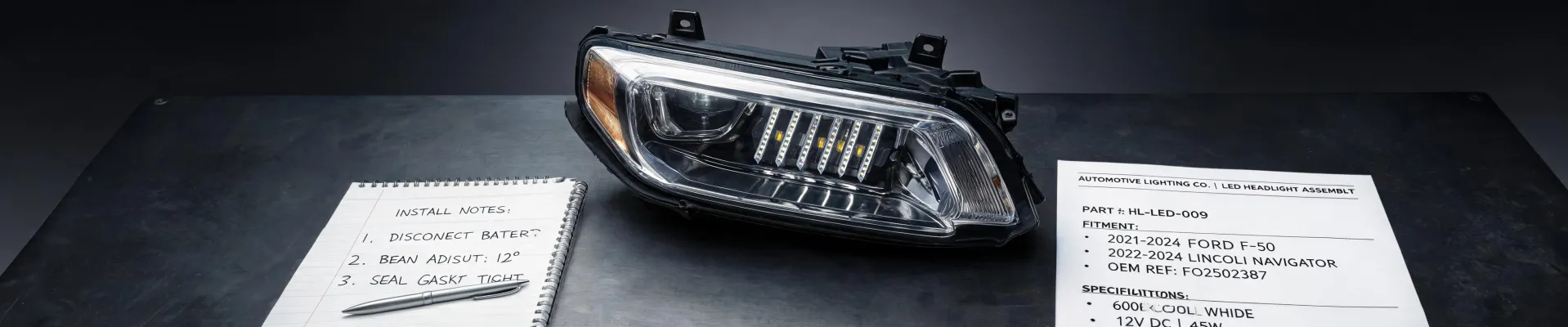
Morimoto F350 headlights are a prime example. A generic housing can cost half as much. It can also scatter light differently, fail an aiming inspection, and lack the thermal management for LED bulbs. For a fleet truck, the cost isn't the housing—it's the rework appointment, the vehicle off the road, and the driver complaining about visibility.
I don't have hard data on accident rates from aftermarket headlights. But based on five years of warranty claims and return logs, my sense is that the cheapest light assemblies fail or disappoint at a much higher rate. In our system, the failure cost includes labor, shipping, and customer follow-up. That usually exceeds the price difference in the first incident.
What Is a Motor Starter? It's a Cost Question
What is a motor starter? In plain terms, it's a device that starts and stops an electric motor and protects it from overload. But in procurement, the better question is: which motor starter is correct for this motor?
According to NEMA standards (nema.org), motor starters are classified by size and application. A 'universal' starter may fit the mounting pattern but have the wrong overload range or coil voltage. I once ordered a cheaper replacement based on fit. The contacts welded closed within a month. The replacement cost wasn't the starter—it was the line downtime and the after-hours electrician bill. (Should mention: the 'cheap' option resulted in a $1,200 redo when quality failed.)
Stop Leak Radiator Treatments: A Temporary Answer You Shouldn't Treat as Permanent
Stop leak radiator treatments are useful. They can seal a pinhole leak in an emergency and buy you time. But I learned never to assume a $15 bottle is cheaper than a $300 radiator replacement. Didn't verify. In one case, a cracked tank was the real issue. The stop leak clogged a heater core, and the final repair bill was $1,200 more than the straightforward replacement would have cost.
Now our policy is simple: diagnose first, then decide. If the radiator is old and corroded, the treatment is a gamble. The safe move is to replace the cooling system component with one that has a real warranty and a confirmed delivery date.
The P1000 Strut Lesson: A Part Number Is Not a Specification
I see the same pattern with suspension parts. Take the P1000 strut—or rather, the full strut assembly. Two suppliers can quote the same part number, but one may be valved for a lighter vehicle or lack the required internal bump stop. If you install the wrong spec, you'll hear about it in the first test drive. The rework and customer frustration are real costs.
Three things matter before price: confirmed spec, agreed timeline, clear labor coverage. In that order. If a supplier can't confirm all three, their quote is just a guess.
The Counterargument: 'You're Just Paying Brand Tax'
I used to think that too. Then I tracked failures across 12 suppliers over three years. The 'budget' brand had a 9% initial defect rate; the OE-spec supplier was under 2%. I don't have hard data on industry-wide defect rates, but based on our order history, my sense is that cheap parts fail 3 to 4 times as often in first use. The rework labor alone erased the savings.
People think expensive vendors deliver better quality. Actually, vendors who deliver quality can charge more. The causation runs the other way.
That doesn't mean every premium brand is worth it. It means you have to look at the failure cost, not just the purchase price. A part that costs 40% more but fails half as often is cheaper over its life.
When It Makes Sense to Take the Risk
I don't want to sound dogmatic. If you're repairing a vehicle you're going to sell in a week, a generic part might be rational. I can only speak to my context: a mid-size parts supplier whose customers need uptime. If you're dealing with a one-off job and a flexible schedule, the cheapest option may be fine. Your mileage may vary.
The Real Cost of Certainty
So yes, I pay for certainty. I pay for Morimoto LED tail lights when beam pattern and durability matter. I choose Morimoto F350 headlights for the same reason. I specify the P1000 strut with load ratings, not just a part number. I treat stop leak radiator treatments as an emergency stopgap. And when someone asks me what is a motor starter, I tell them: it's a part that prevents expensive downtime—if you choose it correctly.
The lowest quote is not the lowest total cost. Total cost includes delivery certainty, defect risk, rework labor, downtime, and the quiet cost of telling a customer, 'We'll have it Friday' without meaning it. (Should mention: we now build a 3-day buffer into every promised deadline.) That buffer costs money. It's worth it.