-
What This Comparison Actually Costs
-
Dimension 1: Retail Price vs Total Installed Cost
-
Dimension 2: Headlight Bulb Replacement Cost and Why Labor Is the Real Line Item
-
Dimension 3: Electrical Load and the Alternator Question
-
A Non-Lighting Comparison: The Fram XG9100 Oil Filter
-
The Time Certainty Premium
-
Which Option Should You Buy?
What This Comparison Actually Costs
I manage purchasing for a 42-person fleet service company. I've overseen roughly $340,000 in annual parts spending for over seven years, and almost every invoice passes through my cost-tracking spreadsheet. When I first started buying aftermarket lights, I assumed the part with the right connector was good enough. Then a $65 tail light on a customer's Bronco filled with condensation after ten months. The warranty exchange took six weeks. The labor to reinstall it cost more than the original tail light. I learned that lesson the expensive way.
This article isn't a Morimoto advertisement. I don't earn a commission if you buy premium lights. But when someone asks me whether Morimoto Bronco tail lights or Morimoto XRGB LED headlights are worth the higher price, I don't answer with a brand opinion. I answer with the same comparison I use for any part: initial price, installed life, failure cost, and delivery certainty.
Dimension 1: Retail Price vs Total Installed Cost
Let's start with the obvious number. Based on online retailer listings I checked in January 2025, quality LED tail lights like Morimoto Bronco tail lights land in the $800 to $1,100 range. Generic Bronco tail light assemblies are often $250 to $450. A buyer who only looks at the invoice sees a $500-plus difference.
But that invoice price doesn't include what happens next.
In Q2 2024, I bought twelve no-name LED bulbs for two fleet models. They cost $26 each instead of the $95 units we normally buy. Five of the twelve caused flicker, warning lights, or sporadic failures within four months. Our technicians spent 7.2 hours diagnosing problems that turned out to be the cheap bulbs. At our internal labor rate of $95 per hour, diagnostic labor alone was $684. The cheap parts had a total cost of $312 in product plus $684 in labor. I entered every hour in our maintenance system, so I can show you the math. The high-quality parts would have cost more upfront and essentially zero diagnostic labor.
That is the difference between retail price and total installed cost. Budget parts usually win on the first number. They rarely win on the second.
Dimension 2: Headlight Bulb Replacement Cost and Why Labor Is the Real Line Item
People search for 'headlight bulb replacement cost' because they want a number before they commit. There isn't a fixed number. A halogen bulb at a parts store can be $12 to $30. A good LED upgrade can run $100 to $200 per bulb. A complete headlight assembly can be $400 to $1,200 before labor.
What people forget is the labor side. On many late-model trucks and SUVs, swapping a headlight bulb requires removing the bumper cover, fender liner, or battery tray. At $110 per hour, a $25 bulb can become a $250 job. If that bulb fails in a year and has to be replaced again, you have paid for a premium part two or three times over.
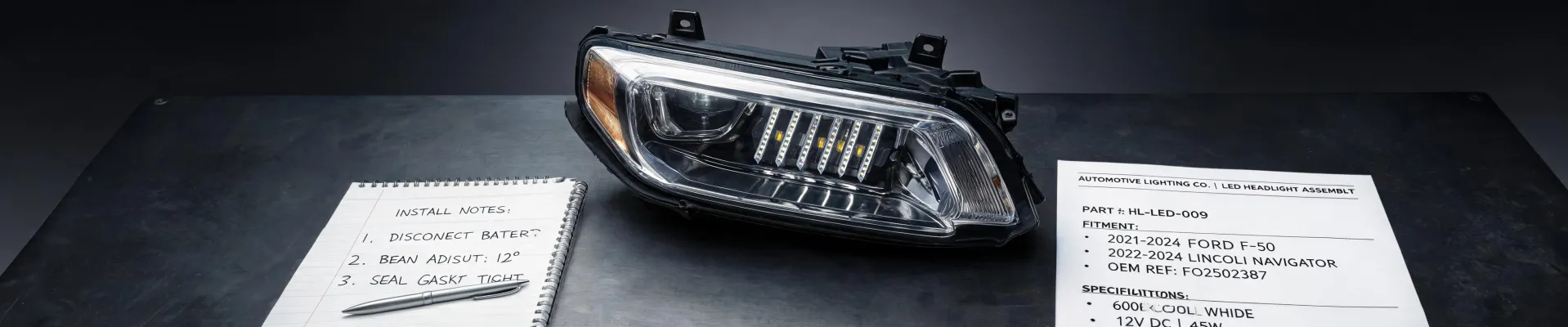
This is where Morimoto XRGB LED headlights make more sense to me than the price tag suggests. I'm not an electrical engineer, so I can't speak to the thermal modeling inside the housing. From a purchasing perspective, what matters is that the premium unit includes optics and driver electronics designed to work together. Budget alternatives often use a bulb that fits but doesn't create a clean beam pattern. That hidden mismatch is what eats time and money.
Dimension 3: Electrical Load and the Alternator Question
Another cost that never appears on a spec sheet is electrical compatibility. This may sound like a maintenance issue, not a comparison issue, but it belongs in every lighting decision.
How long can a car run without an alternator? With a fully charged battery and a low electrical load, most vehicles can run for 40 to 60 minutes before voltage drops enough to cause problems. But with cooling fans running, auxiliary lights on, infotainment awake, and fuel pumps pulling current, that time can shrink to 10 to 20 minutes. Modern engine computers do not tolerate low voltage well. When the battery drops below a critical level, the engine can stall, often without warning.
So why does that matter for Morimoto XRGB LED headlights? Because every electrical part you add affects your alternator and battery. High-quality LED drivers are designed to stay within reasonable current draw and produce less electromagnetic noise. Cheap drivers can cause pulsing voltage readings, disable daytime running lights, or create warning codes. You then pay a diagnostician to find a problem that did not exist before the part went in.
It also matters for the emergency scenario. If an alternator fails during a road trip, the best headlight in the world will not help when the engine is dead. You want your lighting and other electrical upgrades to draw as little unnecessary current as possible. That is another argument for comparing driver quality, not just brightness.
I can't give you exact load numbers for every aftermarket product. I can tell you that reputable manufacturers publish current draw specs, while no-name brands often don't. Lack of a spec is a cost, even if it doesn't appear on the invoice.
A Non-Lighting Comparison: The Fram XG9100 Oil Filter
If this logic only applied to lights, you could ignore it. It doesn't.
Take the Fram XG9100 oil filter. It is not a glamorous part, but it is one of the products I buy because the maintenance interval in our fleet schedule needs it. A generic filter in that application costs about $6.50 in our account. The Fram XG9100 costs roughly $17. The oil change labor is identical. The filter is different because it is designed for longer synthetic oil service intervals. Paying an extra $10.50 reduces the chance of the filter failing before the next oil change. For a vehicle with a loaded schedule, that $10.50 purchases certainty.
That is the same mental model I use for headlights. The question should never be 'does the cheap version work?' It should be 'can the cheap version work for the full time you need it?' If not, it isn't cheap.
The Time Certainty Premium
When I audit our purchasing data, one pattern stands out: the costliest parts are rarely the most expensive ones. The costliest parts are the ones that arrive late, don't fit, or fail immediately after installation.
A few months ago, a customer needed his Bronco ready for a 1,200-mile trip. The factory tail light was broken, and his departure date could not move. We quoted a budget replacement and Morimoto Bronco tail lights with labor. The budget option cost less. It also had a vague delivery promise and no guarantee that the bracket would line up. The Morimoto option cost more, but our supplier had it in stock with a confirmed delivery date and a warranty process I could actually reach.
He chose Morimoto. That's the time certainty premium: you pay extra for a confirmed answer, not for a guess. After getting burned by several uncertain sources, I've stopped treating that as an emotional decision. It's a calculated one.
This is why I don't mind paying for validated shipping, a documented warranty, or a technical support line. If the deadline is flexible, go ahead and gamble. If the deadline is not flexible, buy certainty instead of hope.
Which Option Should You Buy?
After all those numbers, here is my honest buying rule.
- If you are keeping the vehicle for three or more years, or you depend on it for work, recreation, or long-distance travel, Morimoto Bronco tail lights and Morimoto XRGB LED headlights are worth the premium. Divide the price difference by the years you will use the part, and it starts to look less dramatic.
- If you are flipping a vehicle or building a trailer queen, basic aftermarket lights might be enough. Just keep the original boxes and assume some returns.
- If you are on a tight budget, don't buy the cheapest possible version. Buy an older or simpler premium design instead of a newer no-name model. A used premium set generally beats a new uncertain set from a cost perspective.
- When you need a part by a date, let the deadline drive the choice. A cheap part with an unconfirmed arrival date is more expensive than a premium part that is already in transit.
This may not be the answer a fan site would give. I'm okay with that. I've paid for cheap parts more than once and discovered that repair costs have a way of catching up. Not every budget part fails. But if it does fail, it fails at the moment you can least afford it. That's not a bad-luck bias; it's a decision cost.
Before you compare headlight bulb replacement cost, ask yourself what the replacement will cost when you have to do it again. If a replacement takes an hour because the bulb is buried behind the front bumper, a premium long-life bulb is not an indulgence. It is a labor-saving purchase.