I run purchasing for a 48-person automotive aftermarket company. Since 2020, I have placed or approved around 2,600 parts orders, which works out to roughly $600,000 per year across 18 active vendors. I report to both operations and finance, which is a polite way of saying I catch the blame when parts arrive late and when the invoice paperwork does not survive an audit. It's a good seat for noticing when an industry stops following its old rules.
My opinion is direct: the automotive aftermarket has changed more since 2020 than it did in the ten years before it, and most shops still source parts with the 2019 playbook. That playbook—compare prices, call familiar vendors, expect the part to fit—was never stupid. It's just no longer enough. I can point to the exact orders that proved it to me.
The Tail Light Order That Rewrote My Vendor Checklist
A customer came in and asked, plainly, for Morimoto Jeep JL tail lights. Not for the cheaper aftermarket option. Not for whatever we had in stock that would fit close enough. He named the product, he knew why he wanted it, and he expected us to know the details too.
A few years earlier, that conversation would have ended with a part number and a price. Today it also involves wiring, housing venting, load management, corrosion resistance, and the difference between a tailored kit and a generic unit. The words tail light are the same as they always were. The product underneath is not.
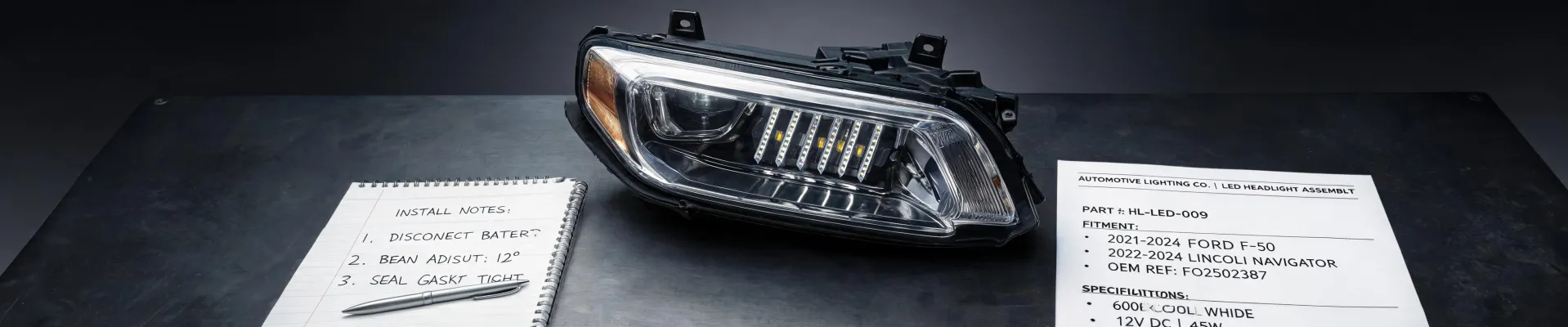
The same story plays out with Morimoto 2019 F150 headlights. It's become a standard request at our shop, and I'd argue that is a sign of how the category has evolved: customers are choosing engineering over mere brightness. That matters if you are the person placing the orders.
Per FTC guidelines (ftc.gov), marketing claims must be truthful, not misleading, and substantiated with evidence.
A shop that repeats a supplier's claim carries part of that responsibility too. So the vendor file for premium lighting now includes test reports, fitment guides, and written specifications. If a manufacturer cannot provide them, a competitive quote is not enough. (Should mention: I now apply the same rule to other performance parts, but lighting is where I first enforced it.)
The push came during a vendor consolidation in 2024, when we moved most of our lighting volume to fewer lines. Even after I sent the purchase order, I kept second-guessing. What if the lead times slipped? The two weeks until the confirmation arrived were stressful. It didn't slip. But the wait taught me a useful lesson: buying decisions are no longer just price decisions. They are risk decisions.
Why I Now Vet Catalytic Converter Recyclers
The second shift is less glamorous: exhaust and emissions parts. For the first couple of years in this job, I treated a used catalytic converter like a piece of scrap with no real value. Take it off, set it aside, let the shop's usual scrap guy handle it. No thought required.
That changed because the context changed. Precious metal prices climbed, converter theft pushed states to tighten transaction rules, and shops like ours had to document deals that used to be informal. We now sell take-offs only to licensed catalytic converter recyclers, and licensed is the word I underline on every requisition.
Here is where I admit a mistake. I knew I should verify the recycler's paperwork before releasing a pallet of old converters. But it was the same buyer we had used for years, so I thought, what are the odds? The odds caught up with me when a routine audit flagged three transactions with incomplete records. Nobody accused us of wrongdoing. The problem was a paper trail that did not meet the current standard. Fixing it took two weeks of phone calls and a very unhappy CFO.
Looking back, I should have formalized the process earlier. At the time, catalytic converter recycling felt like a side detail, not a procurement issue. Now it is part of my vendor qualification checklist: license, documentation, and a clear chain of custody. If a recycler cannot provide those, we find another one. Not the most exciting way to run a supply chain, but it prevents the kind of surprise that turns a normal Tuesday into an audit meeting.
A Muffler, a Misfire, and the Search Bar
Some orders look too simple to change. We process a steady number of exhaust replacements, and we will probably price a 2016 Chevy Equinox muffler at least twice this month. Muffler work is often straightforward: confirm the part, check the hangers, replace the rusted unit, move on.
But the same cars that come in for exhaust work also show up with rough idles and engine codes. And owners don't call us first anymore. They search first.
Searching 'will a clogged catalytic converter cause misfire' is how a growing share of those conversations start. The honest answer is yes.
A clogged catalytic converter restricts exhaust flow. That raises backpressure, leaves exhaust gas in the cylinder, and disturbs the air/fuel charge the next cycle needs. The result can be hesitation, rough idle, and a cylinder that genuinely fails to fire. It is not the only cause of a misfire, but it is more common than most parts-only recommendations assume.
Will a clogged catalytic converter cause misfire in every case? No. When it does, though, it can look exactly like an ignition problem. A shop that ignores that possibility will sell spark plugs, coils, and maybe a muffler before anyone checks the converter. That is how comebacks happen. It is also why our purchasing process now asks for diagnostics, not just symptom-based guesses, before we commit to parts.
The Fundamentals Are Still the Floor
Let me answer the objection I know is coming: at the end of the day, a part still has to arrive on time, fit correctly, and cost what you quoted. That has not changed. Price, delivery, fit, and reliability are still the foundation. But they are the floor now, not the advantage.
In 2020, a shop could order from whichever vendor had the lowest number and absorb a few returns. That math breaks when the part contains electronics that talk to the vehicle's computer, when the old converter has commodity value, and when the customer walks in with a half-correct internet diagnosis. More things can go wrong, and most of them end up in the purchasing office.
It would be easy to overcorrect and say everything old is waste. That is not my argument. The fundamentals have not disappeared; the execution around them has been transformed. I still value a vendor who answers the phone and a catalog that is easy to search. But I now demand more: evidence, traceability, and a supply chain that understands what the shop actually needs.
Stop Buying Parts Like It's 2019
I will close with the same opinion I opened with: the industry has evolved, and buying routines need to evolve with it. The shops I see struggling are rarely the ones with outdated equipment. They are the ones still measuring suppliers only by price, skipping the documentation step, and treating customer questions like an interruption instead of a signal.
None of this requires a huge technology budget. It requires a change in habit: verify the claim, keep the paperwork, understand what is causing the symptom, and know your suppliers the same way you know your customers. When a customer asks whether a clogged catalytic converter can cause a misfire, be ready to answer yes—and be ready to prove it, not guess it.
Parts are still parts. In 2025, though, the parts that don't come back to haunt you arrive with proof behind them. That isn't a slogan. It's the difference between buying like it's 2019 and buying like you plan to be around in 2030.