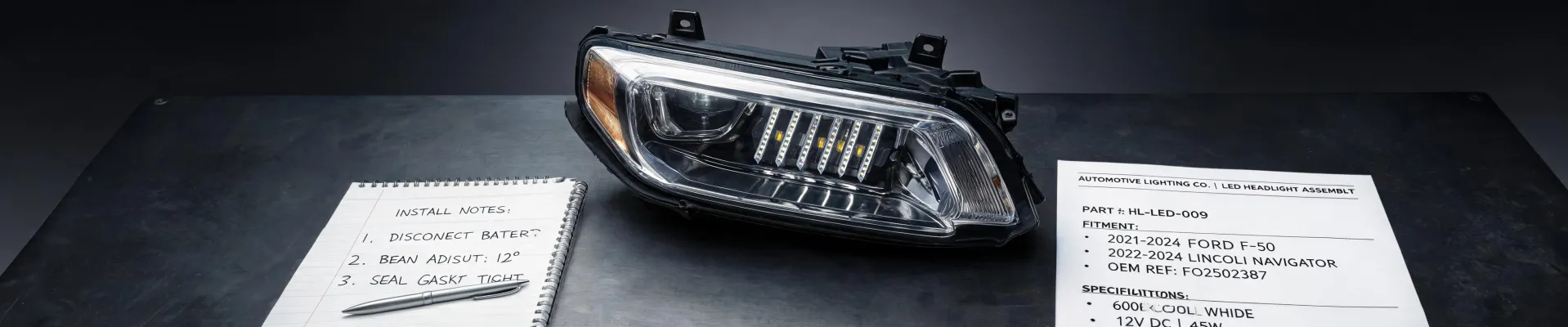
I've spent the last nine years on the purchasing side of the aftermarket parts world, mostly ordering lighting and replacement components for install shops. I've personally made—and documented—five significant buying mistakes that cost roughly $38,000 in re-shipping, restocking, and rushed orders. That's why I maintain the checklist our team uses now. If you're looking for a simple “always buy this brand” answer, I can't give you one. Replacement-part buying is not one situation; it's three.
Searching “Morimoto Jeep JK headlights” and searching “RV thermostat replacement” both start with a product problem. But the first is a branded upgrade decision, and the second is a system-compatibility decision. The right process depends on which one you're actually in.
The mistake that changed my process
Back in March 2022, I placed a purchase order for a set listed as Morimoto 4th Gen RAM headlights. The shop customer had a 2015 Ram 1500, so the generation looked right. It looked fine on my screen. But when I sent the VIN to the distributor's compatibility check, the order bounced. The part number did not match the truck's original lamp configuration. What looked like a simple branded headlight order was not so simple.
The cost was a 3-day delay plus a $214 expedite charge. Worse, it taught me that I had been treating a search phrase as if it were a technical spec. “4th Gen RAM” was the category. It was not the fitment answer.
The first situation: it's a branded product with a genuine reputation
When someone searches for Morimoto Jeep JK headlights or Morimoto 4th Gen RAM headlights, they usually want a known brand. That's a legitimate reason to start there. A reputable brand usually means better optics, more consistent quality control, and actual support.
But a good brand does not remove fitment risk. The same rules I use for an expensive headlight order apply to any branded part:
- Use fitment data, not just search data. The product title says “JK” or “4th Gen,” but you still need the exact part number and the vehicle details behind it. If the supplier asks for the VIN or the original lamp package, that's a good sign.
- Ask what is not included. Harnesses, adapters, brackets, modules, shipping, restocking—there is always something that can be left off the quoted price. I've learned to ask “what's NOT included” before I ask “what's the price.” The vendor who lists all fees upfront—even if the total looks higher—usually costs less in the end.
- Use an authorized seller. A warranty is only as useful as the channel you bought it through. If a listing undercuts the authorized price and offers no warranty pathway, that's a risk you should price into the order.
Per FTC advertising guidance (ftc.gov, as of January 2025), claims like “fits your JK” or “OEM-style” need to be truthful, not misleading, and substantiated. That is not just legal language. It means a good supplier should be able to show you the basis for its compatibility claim. If they won't, they are asking you to do their engineering homework.
The second situation: your main risk is service, not part number
Reviews have a different job. Suppose someone searches “Muffler Mart of Boston Inc reviews” before having exhaust work done. That's a sensible way to evaluate a local service provider. Reviews tell you how the shop communicates, whether their quotes are complete, and how they handle warranty callbacks.
What reviews do not tell you is whether the shop's supplier actually validates the parts. I made that mistake once with a vendor that had excellent reviews. The data said yes—great ratings, good response time, fair price. My gut said no: the quote had labor hours but no part numbers or manufacturer sources. I went with the data anyway. The replacement part failed three months later, and the install labor made the comeback far more expensive than the part itself.
That was a category error. A service reputation can prove communication and workmanship. It cannot prove product quality. If a vendor's reviews are good but their quote says nothing about part numbers, return policy, or manufacturer sources, ask for those details before you book the job.
The third situation: physical fit is not enough
The fastest way to waste money in the replacement business is to assume that because a part fits, it will work. This is exactly where I see RV thermostat replacement mistakes.
An RV thermostat can share the same wall plate and still fail to operate because voltage, furnace control logic, or AC control signals are different. It can fit perfectly and do nothing useful. In vehicle lighting, the same principle applies. A headlight housing may bolt in without drama, but the vehicle's electrical system needs the right connector, driver, and vehicle configuration. If a supplier can't describe which configurations the part is compatible with, that is a red flag.
The exercise I force myself through before any purchase: write down the system facts first, then choose a part number. Brand name, price, reviews, and star ratings all come after the compatibility requirements.
How to tell which situation you're in
If you're making this decision for your own vehicle, you can still feel the difference instantly by asking yourself one question: if this order fails, what will I lose?
- If the failure would be mostly the cost of the part, you're in the branded product situation. Verify fitment, warranty, and what's included.
- If the failure would happen after installation and the bigger cost is labor or customer trust, you're in the service situation. Check the person or shop doing the work, then check the part data separately.
- If the part could fit physically but still not work because of wiring, electronics, or control logic, you're in the system compatibility situation. Start with specs, not searches.
For a professional purchase, use all three. Resellers and installers shouldn't pick one signal. The price is not transparent until the product, the service, and the system compatibility are all documented.
My final transparency checklist
The list below is unglamorous. It prevents most of the expensive mistakes I've made and documented.
- Exact manufacturer and part number. “Compatible with Morimoto” is not a part number.
- Authorized dealer status or written permission to use the brand.
- What's included in the price: harnesses, adapters, brackets, modules, programming?
- What's not included? That question gets asked before the purchase.
- Return/restocking policy and who pays the freight on a return.
- Fitment evidence: vehicle model, year, trim, lamp package, or VIN confirmation.
The most expensive lesson from my early years was not about a bad product. It was about asking the wrong question. I asked “which headlights should I buy?” when I should have asked “how will I verify this part works on this vehicle through this seller?” If you start with that second question, you will know which situation you're in. If a supplier doesn't like the question, you already have your answer.