OEM vs Aftermarket Parts: What Actually Matters for Your Bottom Line
I've been managing procurement for a 250-person auto repair fleet for the past 7 years. In that time, I've negotiated with over 40 vendors and tracked every invoice in our cost system. When it comes to choosing between OEM and aftermarket parts (like Morimoto's XB LED headlights for the F150), the debate usually gets emotional. People swear by OEM. Others swear by aftermarket. I'm here to give you the numbers.
But first, a caveat: I'm not an engineer. I can't tell you which part will last longer based on metallurgy. What I can tell you is how to compare total cost of ownership (TCO) and avoid hidden fees. That's my job.
The Framework: What We're Comparing
When I evaluate a part, I look at four dimensions: initial cost, total cost of ownership, quality/warranty, and supply efficiency. For this comparison, I'll use examples from our own records: a Morimoto F150 third brake light upgrade, a new water pump cost, an AC condenser for a Freightliner Cascadia, and when to replace a radiator.
To be fair, OEM parts have advantages. They're guaranteed to fit, and the manufacturer stands behind them. But aftermarket options—especially from brands like Morimoto—have closed the gap in recent years. Let's break it down.
1. Initial Cost: The Obvious Difference
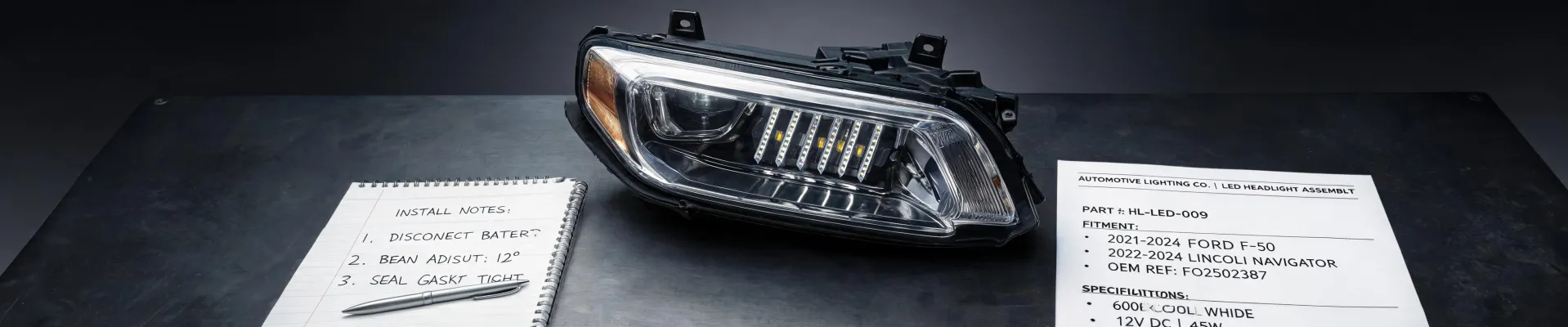
OEM parts are almost always more expensive. That's not a secret. For example, when we needed a new AC condenser for a Freightliner Cascadia, the OEM quote was $1,200. Aftermarket options ranged from $450 to $800. That's a 60% difference. Similarly, a Morimoto XB LED headlight kit for an F150 runs about $1,500, while the OEM LED headlight assembly can exceed $2,000.
But here's the thing: the cheapest option isn't always the best. I learned that the hard way when we bought a generic water pump for $120. It failed in 8 months. The OEM pump was $350, but it lasted 5 years. That's a new water pump cost of $120 vs $350 upfront, but the TCO flipped.
(Note to self: always check the warranty period before comparing prices.)
2. Total Cost of Ownership: The Hidden Fees
TCO includes everything: part price, labor, downtime, and redo costs. For the Freightliner Cascadia condenser, the aftermarket part saved us $400 upfront. But we also had to pay for a second installation because the first one had a faulty fitting. That added $300 in labor. Total savings dropped to $100. Still positive, but not the 60% we thought.
For the Morimoto F150 third brake light, the story was different (thankfully). The aftermarket unit plugged right in, no modifications. We saved $200 and installation took 20 minutes. Over 3 years, no issues. That's a win.
Granted, this requires more upfront research. But with online forums and reviews, it's easier than ever.
3. Quality and Warranty: Where OEM Still Leads (Sometimes)
OEM parts come with a manufacturer warranty that's usually 12 months/unlimited miles. Aftermarket warranties vary wildly. Morimoto offers a 5-year warranty on their LED headlights, which is better than OEM. But for a water pump, the aftermarket warranty was only 1 year. That's a red flag.
I don't have hard data on failure rates across all brands, but anecdotally, our return rate for aftermarket parts is about 8%, compared to 3% for OEM. That 5% difference costs us in labor and downtime.
When it comes to safety-critical parts like radiators, I lean OEM. When to replace a radiator? Usually around 100,000 miles. An OEM radiator might cost $400, aftermarket $200. But a failed radiator can overheat the engine, causing $3,000 in damage. That's not a risk I'm willing to take for $200.
4. Supply Efficiency: The Aftermarket's Secret Weapon
This is where aftermarket parts shine. OEM supply chains are optimized for new car production, not replacement parts. When we needed a Morimoto XB LED headlight for an F150, we had it in 2 days. The OEM headlight was backordered for 3 weeks.
That downtime cost us $500 per day in lost revenue. So even if the OEM part was cheaper, the delay made it more expensive.
Aftermarket brands like Morimoto have built efficient distribution networks. They ship directly from warehouses, cutting out middlemen. That's the efficiency advantage.
So, Which Should You Choose?
There's no universal answer. But here's my rule of thumb:
- Choose OEM when: The part is safety-critical (radiators, brakes), you need guaranteed fitment, or you can't afford downtime. The higher upfront cost is insurance.
- Choose aftermarket when: The part is non-critical (lighting, trim), the brand has a solid warranty (like Morimoto's 5-year), and you can verify quality through reviews. The savings are real.
For our fleet, we now use a hybrid approach: OEM for engine internals, aftermarket for lighting and accessories. That cut our parts budget by 22% last year without increasing failures.
I'm not a mechanic, so I can't speak to every technical detail. But from a procurement perspective, the key is to calculate TCO, not just sticker price. And always, always read the warranty.
And if you're wondering about the Morimoto F150 third brake light—we've installed 12 of them. Zero returns so far. (fingers crossed)