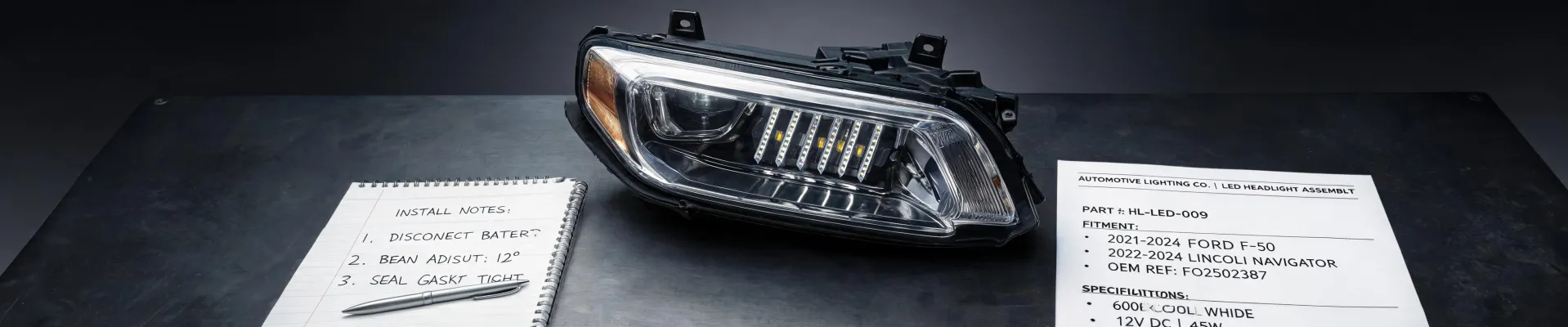
The day our file server died, I had three orders on my desk: a 6.4 Hemi oil pump bracket prototype, a 2,500-piece catalytic converter heat shield for a Hyundai Sonata, and the first bezel run for the Morimoto XRGB Bronco headlights. I remember printing the schedule and thinking this would be the week we proved our new in-house die line could handle everything at once. Instead, we proved that a bad backup habit can undo a whole production plan.
I'm a production coordinator at Morimoto. I've been handling stamping and die orders for OEMs and Tier 1 suppliers for about nine years. I've personally made (and documented) seven significant mistakes, totaling roughly $28,000 in wasted budget. This one was the worst. Now I maintain our team's checklist to prevent others from repeating my errors.
Backup was never my job. That's part of the problem. Our IT guy had been telling me for months to switch from incremental to differential backups. In his world, this was urgent. In my world, incremental backups were faster, smaller, and they ran every night. I didn't see the point of changing. It's tempting to think any backup is better than none. But a backup you can't restore isn't a backup. It's just an expensive pile of files.
The failure happened on a Tuesday. I want to say it was October 2023, but don't quote me on the date. The server just wouldn't boot. Our IT guy got on the phone and explained what we needed to do: open the backup software, load the catalog, and restore the latest image. Sounded simple. The software was not happy. We had 43 incremental backup files in the chain. The most recent one was corrupt. The last usable one was from the previous Friday. So we lost four days of CAD work, including the latest revisions on the 6.4 Hemi oil pump bracket.
I remember staring at the screen, waiting for the restore progress bar to move. It didn't. We tried the previous file. Then the one before that. Each attempt gave us a different error. The IT guy finally said what nobody wanted to hear: 'The chain is broken.' That's when I learned why the incremental chain is fragile. Every backup assumes the one before it is valid. If one link is bad, everything after it is suspect.
After the incident, the first thing I did was write down every step we followed: who approved the backup schedule, when the last test restore had been done, what files were affected. That checklist was ugly. But it turned into the pre-flight check we still use before any major die change. It includes a restore test before we delete old revision data. That's the kind of process checkbox that sounds boring until it saves your week.
The timing could not have been worse. Because Morimoto makes dies and molds in-house, we can usually recover faster than a shop that outsources tooling. But you can't recover from a file that doesn't exist. We had to recreate the progressive die design for the 6.4 Hemi oil pump bracket from an old PDF and a stack of handwritten notes. That ate up six days. The catalytic converter Hyundai Sonata heat shield order was pushed back because the press was tied up. Then the Morimoto XRGB Bronco headlights bezels couldn't start on schedule. Everything slipped.
I haven't even mentioned the used Morimoto headlights email. That same week, someone asked if we could rebuild used morimoto headlights—re-lens a pair they'd bought online. We had to say no because engineering was busy reconstructing files. So one bad backup decision cost us a sales conversation too. I can't put a dollar figure on that, but I think about it every time someone says backups can wait.
Never expected the restore to be the bottleneck. Turns out the backup was fine until you needed it. They warned me about this. I didn't listen. The server died. That's how I learned that differential vs incremental backup isn't just IT trivia.
Basically, incremental backup saves only what changed since the last backup. It's fast and small, but to restore you need every file in the chain. Differential backup saves everything that changed since the last full backup. It uses more storage, but restore only needs the last full backup plus the latest differential. That's way more reliable for production data.
We switched to daily differential backups plus a weekly full backup. We also automated the job so nobody has to remember to run it. Plus, once a quarter, we do a test restore. Our last test took about 45 minutes. The old process would have taken hours—and that was on a good day. Honestly, the difference was way bigger than I expected. It saved us a ton of stress too.
The whole mess cost us about $14,000 in expedite fees and overtime. Maybe $18,000 if you count the customer trust we burned. I'd have to check the numbers. The part that still bothers me is how preventable it was. There's a reason the 3-2-1 backup rule exists: three copies, two different media types, one offsite. We now follow that. At least, that's been my experience with a mid-size OEM supplier, not a giant enterprise, but the principle holds.
From an efficiency standpoint, this wasn't just an IT fix. It was a competitiveness fix. Reducing manual steps means fewer errors. Automating the backup removed the 'did anyone plug in the external drive?' fear. And because we supply automotive parts, documented information has to be controlled. According to IATF 16949, an auditor doesn't care how fast your backup is—they care that you can produce the record. Now we can.
So here's what I tell every new team member: differential vs incremental backup isn't a quiz question. It's the difference between a bad afternoon and a terrible month. If you've ever hit 'restore' and watched it fail, you know that sinking feeling. Trust me on this one.
We still have too many manual checklists around here, and we still make mistakes. But the backup part is fixed. And the next time someone warns me about a risk I think is overblown, at least I'll listen a little longer.