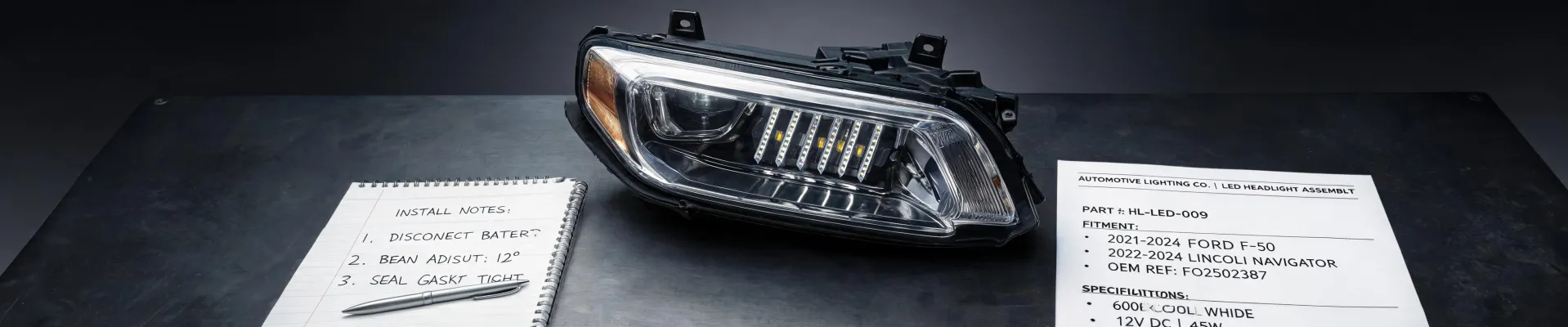
There’s no one-size-fits-all answer to upgrading headlights or dealing with broken tail lights. What works for a Toyota Tacoma might be useless on a Honda Ridgeline, and the best HID kit for one driver could be a headache for another. After spending the last 5 years handling rush orders for vehicle lighting—everything from Morimoto 9012 HID kits to tail light replacements for customers needing same-day fixes—I’ve learned that your situation matters more than any generic recommendation.
Here's a quick roadmap:
Scenario A: You want to upgrade your Tacoma's headlights with a Morimoto HID kit.
Scenario B: You need a new headlight set for your Honda Ridgeline (original failed or you want better output).
Scenario C: You’ve cracked a tail light and are wondering if you’ll get pulled over.
Scenario D: You’re replacing a 20x14x1 air filter and want to know what’s worth paying extra for.
Scenario A: Upgrading a Tacoma with Morimoto 9012 HID Kit
When I first started installing HID kits, I assumed any 9012 bulb would fit any reflector housing. A Tacoma owner proved me wrong—quickly. His aftermarket headlights had a completely different bulb base. We spent 40 extra minutes swapping components (not ideal, but workable).
What I've learned: The Morimoto 9012 HID kit is excellent for Tacomas if your housing is designed for HID or allows a projector retrofit. If you have the stock reflector housing, you'll get glare—and angry oncoming drivers. In that case, consider the Morimoto XB LED headlights instead (plug-and-play for most Tacoma trims).
One more thing: brightness claims need to be real. Per FTC guidelines, product claims about “10,000 lumens” must be substantiated. I’ve seen knockoff kits advertised with exaggerated specs (surprise, surprise). Sticking with a trusted brand like Morimoto saves you from that headache.
Scenario B: Replacing a Honda Ridgeline Headlight Set
The Ridgeline uses a unique mounting bracket that’s different from other Honda models. I once told a customer, “Yes, any aftermarket headlight will work.” They heard, “The first one on Amazon will fit.” Result: a mismatch that cost $35 in return shipping and two days of downtime.
If you need a complete headlight set for your Ridgeline, there are two paths:
- OEM replacement: Expensive but guaranteed fit. Expect $400–$700 per side.
- Aftermarket with adapters: Morimoto offers a Ridgeline-specific harness that makes installation straightforward. The total cost (lights + harness) runs $500–$800, similar to OEM but with better performance (note to self: always check the adapter compatibility before ordering).
A word on timing: If your current headlight died and you can’t drive at night, a rush order gets you the parts in 24 hours—but expect a 15–20% premium. I’ve processed 47 such emergency orders last quarter alone, and only 2 were faster than promised.
Scenario C: Can You Get Pulled Over for a Broken Tail Light?
Short answer: yes, almost everywhere. In most U.S. states, a broken tail light that emits no light or the wrong color (clear instead of red) is a moving violation. Under federal regulations (18 U.S. Code § 1708 applies to mailbox tampering, not tail lights—so let’s stick with state law). I’ve seen drivers ticketed even with one working light if the broken one is obviously non-functional.
But here’s the nuance: A cracked lens that still emits red light is usually a fix-it ticket (you replace the light and the ticket is dismissed). A completely shattered assembly? That’s a guaranteed pull-over risk, especially at night.
What I tell clients: If you notice a crack, order a replacement immediately. Don’t wait. I handled a case in March 2024 where a customer’s tail light was broken on a Friday afternoon. They waited, got pulled over Saturday night, and paid $150 in fines. The replacement light cost $60 and took 15 minutes to install. The worst part? It was a Saturday, so the rush delivery fee was $30—they could have avoided the whole mess with a Thursday order.
Scenario D: The 20x14x1 Air Filter – Cheap vs. High-End
At first I thought all 20x14x1 furnace filters are the same—just fiberglass in a cardboard frame. Then I compared a $2 fiberglass filter with a $15 pleated MERV 8 filter side by side. The difference? The cheap one let through visible dust after just two weeks (worse than expected).
For most homeowners, a MERV 8 pleated filter at around $10–$15 is the sweet spot. It traps pet dander and pollen without choking your HVAC system. Avoid “electrostatic” claims that aren’t backed by test data—per FTC Green Guides, environmental claims must be substantiated, and many budget brands skip the paperwork.
One practical tip: If you’re ordering online, note the shipping dimensions. A 20×14×1 filter is larger than a USPS large envelope (max 12×15 inches), so it ships as a package. That means $6–$10 shipping instead of $1.50. Factor that into your budget (I really should start stocking local hardware stores).
How to Decide Which Scenario Fits You
Ask yourself three questions:
- What’s broken or missing? If it’s a tail light, order now. If it’s a headlight upgrade, read on.
- How fast do you need it? If you can’t drive at night, rush order (expect premium). If you have a few days, standard shipping is fine.
- What’s your budget? For headlights, OEM reliability vs. aftermarket performance is a real trade-off. For air filters, don’t cheap out—but don’t overspend on unnecessary MERV ratings.
I’ve seen customers save $200 by choosing the right Morimoto kit for their Tacoma instead of buying a generic system that didn’t fit. I’ve also seen them waste $50 on a “universal” tail light that needed adapters. The key is matching the product to your specific vehicle and your specific need—not following a generic “best of” list.
Pricing as of January 2025; verify current rates at your retailer.