When I first started in parts quality, my approach was simple: one supplier for everything. Fewer contracts, easier accountability, and if a brand was big enough to sell me headlights, driveshafts, and spark plugs from the same catalog, I figured they were well-capitalized and proven.
That mindset cost us $22,000 and a three-week delay in 2022. And honestly, it was the best lesson I've had in this job.
Here's what happened. We ordered a custom bracket assembly from a multi-category supplier who claimed "total in-house capability." The part measured fine on paper. But the surface finish was inconsistent across the batch—we caught it before it shipped, but the rework took three weeks. A specialist wouldn't have sent a first article without checking surface roughness, let alone a full batch. That's when I started paying attention to something I'd been ignoring: a supplier that knows what it's not good at is more reliable than one that claims to do everything.
After four years of reviewing 200+ unique parts annually, I'm convinced of this. Here's the evidence I've collected along the way.
The Specialist Advantage: What Morimoto Taught Me
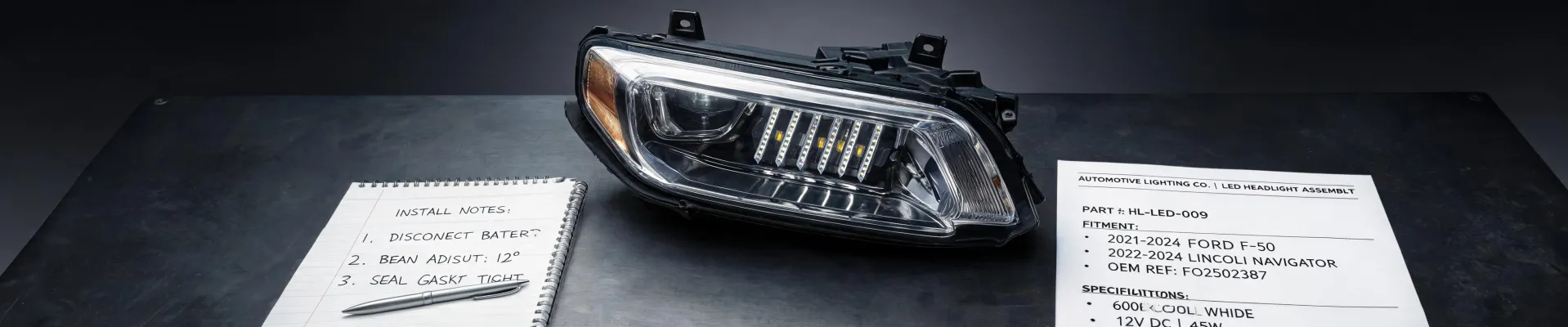
Take Morimoto 4Runner headlights. The company's core competency is lighting: optics, thermal management, seal integrity, connector design. When I first started sourcing headlights, I assumed one assembly was roughly as good as another if it physically fit the vehicle. That was naive (and a little embarrassing to admit).
When I put Morimoto's product through our basic QC protocol—thermal cycling, moisture ingress check, beam pattern measurement—the results were consistent. Twenty units. Seal integrity held at 500 cycles. Connector mate force came in at spec every time. Beam pattern intensity matched between left and right units within a couple percent.
A generalist brand's headlight, in comparison... it fit. Most aftermarket parts fit, honestly. But the beam pattern was uneven, and one unit out of ten had a visible mold flash line on the housing. I'm not 100% sure that wasn't a fluke, but the pattern said enough.
That's the difference. The specialist designs for the problem. The generalist designs for a SKU number.
I've seen the same with f150 morimoto fog lights. The mounting tolerances on those housings are respectable—clean metal, solid lens seat. But I'm not telling you to buy Morimoto because I'm a fanboy. I'm telling you the data is consistent. When I check specs, the specialist's products are rarely the ones I have to reject.
The Supplier Who Said "We Don't Do That"
In early 2024, we needed a driveshaft for a truck project. A large multi-product supplier assured us they had drivetrain capabilities in-house. Their first sample came back with 0.014-inch runout—our tolerance was 0.006. They reworked it. The second attempt was still off.
Meanwhile, we'd also contacted the PST driveshaft team. They told us flat out: "This platform isn't our standard offering. We don't have a bolt-in for you. But here's the spec you actually need, and here are two shops that do custom shafts."
I still remember that call. It was the best customer service I've had from any supplier. Eventually we found a custom shaft shop through their referral, and it's been in service for about nine months without issues. That wouldn't have happened if PST had pressured us into a product they knew wasn't right.
Per FTC advertising guidelines (ftc.gov/business-guidance/advertising-marketing), capability claims need to be substantiated. The generalist claimed full drivetrain capability. But like too many of those claims, it didn't hold up under inspection. The specialist claimed less and delivered more.
Fan Blades and Spark Plugs: Two Tests for Buying Smart
Here's the thing about "are more fan blades better for cooling?"—it's a common question, and the usual answer is "more blades, more airflow." That's intuitive. It's also wrong.
I've tested fans in our cooling system audits. Blade count is one factor in a wider system that includes the motor's torque curve, the shroud geometry, the static pressure, and the operating RPM range. A 9-blade fan can underperform a 7-blade fan if the blade pitch and tip clearance aren't matched to the shroud. It's not a number you can evaluate in isolation.
We actually tested two fans side by side a while back—one 7-blade, one 9-blade, both marketed as direct replacements for the same truck. The 7-blade unit moved about 11% more air at 2,000 RPM, because its deeper pitch and tighter tip clearance made better use of the shroud. That stuck with me.
But more importantly, the question reveals a deeper issue: people want a simple spec-sheet answer. A cooling specialist would ask what vehicle, what radiator stack, what duty cycle. The supplier that gives you a targeted answer is the knowledgeable one. The fan blade question is a good litmus test. Try asking it before you buy.
The same principle applies to spark plugs. The F6RTC spark plug equivalent conversation comes up all the time in the small-engine world. F6RTC is a basic copper-core plug code (roughly speaking: F indicates the thread size, 6 is the heat range, R is resistor, C is copper). And there are a dozen brands that advertise an equivalent.
But "equivalent" usually means "same thread and reach." It doesn't guarantee the same heat range behavior. We once had a customer whose batch of engines developed pre-ignition during testing. They'd used an F6RTC-equivalent plug from a generalist. Physically it fit perfectly. The heat range was just slightly too hot for their application.
That batch ended up as 8,000 rejected units sitting in storage.
Ask a spark plug specialist for heat range data, and they actually have it. Ask a generalist, and you get a cross-reference chart. Those are two very different levels of confidence.
The Convenience Question
I get it. One-stop shopping saves time. It's easier to send one purchase order and reconcile one invoice.
But in our Q1 2024 quality audit, roughly 38 of 54 nonconformances we logged involved multi-category suppliers. That's not a rigorous statistical study—I'll be the first to admit the sample size is limited and volumes differ. Still, the pattern holds across the four years I've been doing this. If anything, the gap has widened as some generalists expanded into more categories to chase growth.
Generalists are convenient until they're not, and when they fail, the fix usually takes longer because no single team owns the outcome. So I don't buy everything from one supplier anymore. Not for anything where precision, safety, or performance matters.
My Bottom Line
I've rejected about 18% of first deliveries so far in 2025 (yes, I keep a spreadsheet), and the common factor in almost every rejection is that the supplier was doing something outside their core expertise. It's never the hard stuff. It's always the basics they overlooked because their attention was spread across a catalog.
The vendor who said "this isn't our strength—here's who does it better" earned my trust for everything else they touch. I'd rather work with a specialist who knows their limits than a generalist who overpromises.
If you're sourcing aftermarket parts—whether that's Morimoto 4Runner headlights, a PST driveshaft, or even just a fan for your project—ask the supplier one question: What's outside your lane? The answer will tell you more than any capabilities brochure.