The Question Every Emergency Call Starts With
A client calls. A part failed. They need it replaced now — not in three weeks, not in three days. And the first decision is always the same: do we grab the cheapest replacement that can arrive in time, or pay more for a brand with a track record?
When I'm triaging a rush order, the first question isn't "what's the cheapest part?" It's "what's the cost of being wrong?" I've been coordinating rush parts replacement for automotive shops and equipment owners for six years. In that time, I've handled 200+ rush orders, including two same-day turnarounds for clients whose customers were waiting on finished work.
When I first started doing this, I assumed the lowest quote that could make the deadline was the right answer. Then I watched a $40 budget part fail four weeks after installation, turning a $200 repair into a $700 one. The discount wasn't a discount. It was a down payment.
Reliability: Brand-Name vs. No-Name
Take the Morimoto fog lights we sourced for a RAM 1500 in March 2024. The client's factory housings cracked after a minor front-end impact. He needed the truck on the road for a job by Monday — the call came in Thursday at 2:30 PM.
We had two realistic options. A generic fog light assembly at roughly half the price, available from a warehouse across town. Or the Morimoto set, which cost more but arrived Friday with proper packaging, sealed connectors, and a known fitment record.
I'm not an engineer, so I can't explain the thermal design or lens coating chemistry. What I can tell you from a procurement perspective is this: generic parts fail at inconvenient times. The no-name housing that looks fine in the box but develops condensation after a month of rain — I've seen that exact scenario three times just this year.
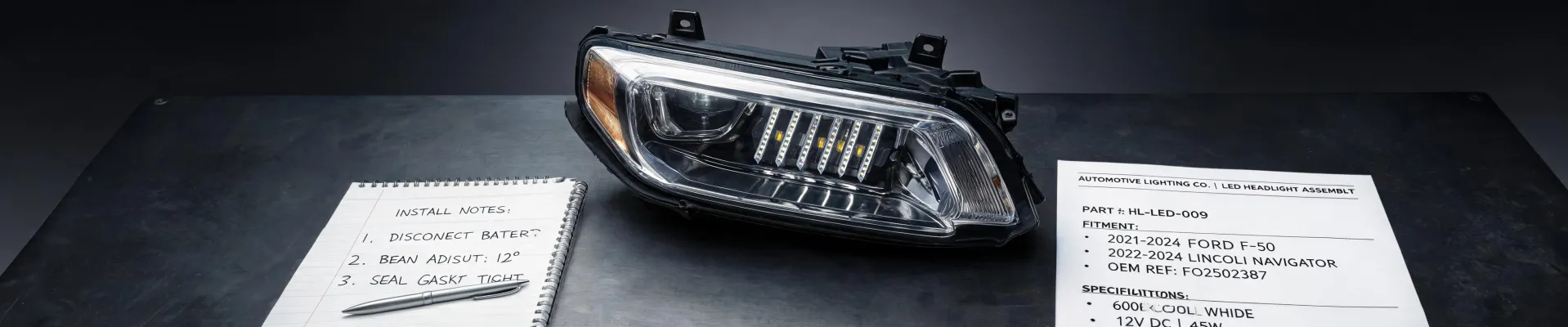
Same story with the Morimoto XB LED headlights we installed on a 4Runner last November. The client was a contractor who left before sunrise on rural roads. The OEM headlights had moisture inside and were dangerously dim. Another aftermarket brand promised "plug and play" for about $300 less. The Morimoto XB set cost more, but it was designed for the 4Runner's specific housing and electrical load — not just "compatible" with it.
Clear comparison here: budget parts say "should fit." Brand-name parts say "designed for." In an emergency, you don't have time to test the difference.
Speed: Real Urgency vs. Manufactured Panic
Here's the part of my job where I changed my mind the most: not every emergency needs emergency handling.
A "radiator repair Boise" call from last September is my favorite example. A client was preparing for a weekend camping trip when his truck started overheating. He called me in a panic, convinced he needed a whole new radiator overnighted at rush rates. I told him to take it to a local radiator repair shop first and get a diagnosis. Turned out it was a cracked hose — a $180 fix that took the shop 24 hours. No rush fee. No overnight freight. The radiator he was about to order would have been $650 plus $120 in expedited shipping — and completely unnecessary.
That was real urgency. But it needed diagnosis, not ordering.
When true emergencies hit, though, they're unmistakable. In January 2025, a client with a Bambu Lab P1S called because the P1S part cooling fan died mid-production run. He had a tradeshow in five days and a dozen printed parts to finish. A $12 generic fan promised 5-day delivery. The OEM-equivalent replacement cost $40 total with 2-day expedited shipping.
The extra $28 bought certainty, not just speed. The generic fan's delivery date was a ballpark. The expedited order was a commitment. If the fan arrived a day late, the client missed his tradeshow slot — an $8,000 loss. The $28 rush premium was the cheapest part of that entire weekend.
Surprising conclusion: rush fees aren't really about speed. They're a certainty premium. You're paying to remove the word "probably" from the delivery equation. In an emergency, that's worth way more than the speed itself.
Total Cost: Sticker Price vs. Replacement Loop
This is the dimension where budget parts look worst — and where I made my most expensive mistake.
When a client asked for the best RV water pump 12V, I recommended a $25 budget pump. The upcharge to a quality model was $75. The client was a retiree who camped maybe eight weekends a year. A budget pump made sense to me at the time. It was a camper, not a commercial vehicle.
Eight months later, the pump failed at 9 PM at a campsite with no cell service. The client had to cut the trip short, drive home on the spare tank, and pay a local repair shop $175 in diagnostic fees just to confirm what I already knew: the pump was dead.
Total cost of that decision: $25 pump + $175 diagnostic + $140 replacement + a ruined weekend + a very annoyed client. I still kick myself for it.
Quality 12V RV water pumps run $80–120 based on what we've seen at major RV suppliers. They use better valves, handle sediment, and last multiple seasons. The budget pump isn't cheaper — it's a smaller first payment in a repeat purchase cycle.
The contrast: cheap parts front-load the savings and back-load the costs. If you only track the first number, you're making the comparison with one eye closed.
Fit: "Compatible" vs. "Engineered"
This is the dimension that catches people off guard, because it's invisible until — well, until it's not.
The Morimoto fog lights for the RAM 1500 weren't just brighter than the generic option. They mounted cleanly into the factory bracket positions, used the existing wiring harness connectors, and aimed correctly out of the box. The generic set — which a different client tried before eventually calling us — required cutting the harness, zip-tying the housing, and aiming with washers as shims. "Install-ready" meant something different to the budget manufacturer.
The P1S fan was the same story in miniature. A generic 24V blower "should have worked." Same physical size, same connector. But the PWM response was slightly different, and the printer's firmware couldn't regulate it correctly. The fan ran — but at the wrong speeds, ruining several prints with inconsistent cooling before we swapped in the OEM-equivalent fan. It fixed the problem in one try. The most frustrating part: we'd flagged the generic fan as a risk, installed it anyway on a tight budget, and paid double in troubleshooting time.
Conclusion here: in an emergency, you can't afford to discover the gap between "compatible" and "engineered" after installation. The second trip to the repair bench is always more expensive than the first.
When the Budget Part Actually Makes Sense
I'm not going to tell you budget parts are always wrong. That would be lazy advice — plenty of aftermarket parts are excellent, and some OEM prices are pure markup. The question isn't "brand vs. no-name." It's "what's the cost of being wrong?"
Scenarios where the budget option is the smart move:
- You have a backup. A second vehicle, a spare machine, a workaround process. The cheap part can be a stopgap while you wait for something better.
- Failure is low-cost. A fan on a hobby printer that fails in a year costs you $20 and an hour, not a missed deadline.
- Downtime is free. If a failed replacement costs you an afternoon, by all means, gamble.
But here's the thing: most emergency calls I get don't look like that. The vehicle has to run. The printer has to finish the job. The camper is 200 miles from the nearest parts store. When the cost of failure is high, the certainty buy — a Morimoto headlight, an OEM-equivalent fan, a quality water pump — isn't a luxury. It's the cheapest option on the table.
Your mileage may vary if you're a hobbyist replacing parts on equipment that doesn't earn you money. But if your time or your client's money has a number attached to it, run the real comparison. Ask yourself: what does a failed replacement cost? Not the part. The failure.
That number is the one that should decide.