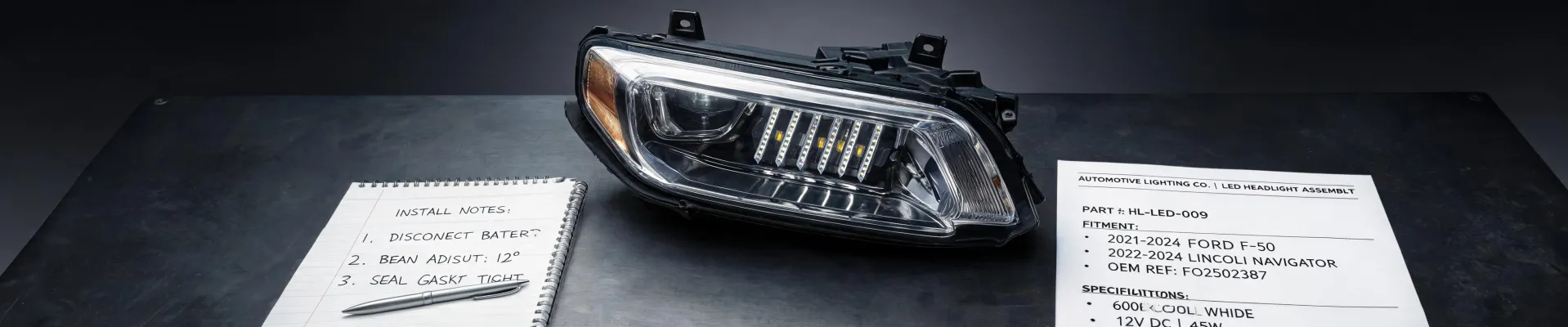
Why are Morimoto headlights so expensive? It's the wrong question
From the outside, Morimoto sits in the premium aftermarket bracket. So the first question people ask is: why are Morimoto headlights so expensive? I get it. I've been a procurement manager at a 45-person auto repair shop for six years, managing a parts budget around $160,000 a year. I've negotiated with 40+ vendors and kept a line-item spreadsheet for all of it.
The problem is the comparison. Most people ask about price without asking: compared to what? Once you put Morimoto next to the real alternatives, the conversation changes.
Upfront price: OEM vs. Morimoto vs. no-name
Here's a ballpark based on public listings I checked in January 2025. Don't hold me to exact numbers, because these move with supply and exchange rates, but the order of magnitude is right:
- Dealer OEM replacement headlight for a late-model Porsche: roughly $3,500 to $6,500 per side.
- Morimoto direct-fit replacement setup: roughly $1,500 to $2,800 for the pair.
- Budget aftermarket housing: roughly $450 to $900.
So if someone asks why Morimoto headlights are expensive, the honest answer is: they're not expensive in context. They look expensive next to a no-name housing. They look like a deal next to a factory Porsche unit that costs more per side than a set of good tires.
This is especially true for Morimoto Porsche headlights. In my experience, people searching for those are usually comparing a complete direct-fit upgrade against the price of an OEM replacement. The OEM part is often sealed, needs coding, and comes with dealer pricing. Morimoto's version is designed as a replacement for the whole assembly.
Total cost of ownership: where the real difference shows
Upfront price is only half the story. Actually, in my world, it's less than half.
When I audited our 2023 spending, I found that 28% of our lighting-related budget overruns came from parts that failed within 12 months. The parts weren't always the cheapest. But the failures were expensive.
Here's a specific example. In Q2 2024, I compared headlight options for an out-of-warranty Porsche. The budget route saved about $700 on paper. Then it needed custom wiring, two return trips, and a new control module when the harness shorted. The total cost landed about $1,300 higher than the Morimoto setup would have cost. Looking back, I should have spec'd the Morimoto units from the start. At the time, the budget housing seemed like a safe save. It wasn't.
The hidden costs I track are the same ones most people don't think about: installation labor, adapters, coding, moisture issues, warranty handling, and the cost of doing the job twice. A cheap part can look great in a quote and terrible in a TCO spreadsheet. I built a cost calculator after getting burned on hidden fees twice.
Value is total cost, not sticker price.
Performance, safety, and one surprise
People assume expensive headlights are about looks. Actually, if you ask me, they're about visibility. Beam pattern, cutoff, color temperature, thermal management—that's what you're paying for. A clean, controlled beam lets you see without blinding oncoming traffic. A bad beam pattern is not just annoying. It can be dangerous.
Why is Morimoto more than a budget housing? Because you're paying for R&D, optical testing, thermal management, and warranty support. A headlight isn't a bulb in a bucket. It's an engineered assembly. That's not hype; it's simply why the parts cost what they cost.
Here's the surprise: the most expensive option isn't always OEM. In some Porsche applications, the factory unit is a sealed assembly. When one internal component fails, you replace the whole thing. A well-designed aftermarket assembly can be more serviceable. So if you plan to keep the car for a while, the aftermarket part can be the one that costs less over time. That feels backwards if you grew up thinking OEM is always the best value. It isn't.
People think expensive vendors deliver better quality. In my opinion, it's the other way around: vendors who deliver quality can charge more. The price is the result, not the cause.
Same cost logic, different parts
This isn't just about headlights. Once you start looking at total cost instead of list price, the same pattern shows up in dirt bike ignition coils, internal water pumps, and head gaskets.
Dirt bike ignition coil
Take a dirt bike ignition coil. A generic coil might cost $25. A coil from a known supplier might be $110. On paper, the $25 coil looks like a no-brainer. But if it fails on the trail, you're not just out $25. You're looking at a tow, a lost ride, and possibly a shorted stator that costs a lot more. A cheap ignition coil is a red flag in an electrical system that can leave you stranded. Sometimes the $25 part works fine. But I wouldn't bet a ride day on it.
Internal water pump
An internal water pump is another perfect TCO test. The name sounds simple, but an internal pump is usually buried behind a timing cover or chain. The part might be $150. The labor to get to it is often five to six hours. If a budget pump fails at 30,000 miles, you're paying that labor all over again. That's why I tell our team to treat internal water pumps as a premium part category. The part is not where you save money when the job is already expensive.
How do I know if my head gasket is blown?
Now the one nobody wants to hear. How do I know if my head gasket is blown? Look for the classic signs: white smoke from the exhaust that doesn't clear, milky oil on the dipstick or oil cap, bubbles in the coolant while the engine is running, and coolant loss with no visible leak. The engine may overheat for no obvious reason.
If you catch it early, you might save the heads. If you don't, you're buying machine shop time and maybe new head bolts. And once you're paying for a head gasket job, the gasket itself is a small line item. A cheap gasket that fails will turn a $2,000 repair into a $4,000 repair. That's the same math as the headlights, the ignition coil, and the water pump.
So, should you buy Morimoto headlights?
Here's how I approach it when I'm on the fence:
- Choose OEM when: the car is under warranty, the repair is being paid by insurance, or you need an exact factory part for resale or lease return.
- Choose Morimoto when: the car is out of warranty, you're replacing a sealed OEM unit that costs thousands, and you want a direct-fit setup with proven optics. This is especially true for Morimoto Porsche headlights.
- Consider budget only when: it's a cosmetic part, it isn't safety-critical, and you're prepared for the chance of early failure. I'd be hesitant to put a no-name coil in a bike or a no-name housing on a daily driver.
Personally, I'd rather explain a higher quote once than explain a redo twice. I'm not 100% sure every Porsche owner needs Morimoto. But I am sure about this: the cheapest quote is not the cheapest repair.
So, why are Morimoto headlights so expensive? In my view, the right answer is: compared to what? Next to a no-name housing, they're expensive. Next to an OEM replacement, they're a value. The same thinking applies to dirt bike ignition coils, internal water pumps, and blown head gaskets. The bottom line isn't the sticker price. It's the cost of the second failure.