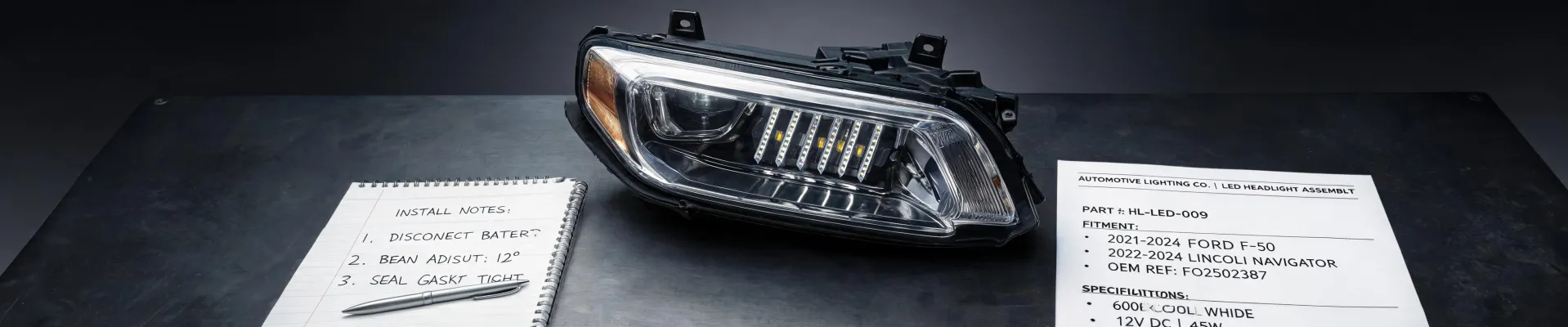
Let's be honest: when a headlight cracks, the first thing you want to do is fix the plastic, not the vehicle. You look up 'how to repair a cracked car headlight', buy a restoration kit, spend an afternoon sanding, and tell yourself it's as good as new. I used to think that way too. Then I started tracking the actual cost of those repairs—not just the $18 kit, but the labor, the reruns, and the replacement that happens six weeks later anyway.
I manage procurement for a 45-person fleet maintenance operation. For the last six years, I've tracked every parts order in a simple spreadsheet. Cumulative vehicle lighting spend alone is over $180,000. That's not a huge number, but it's enough to show patterns: cheap repairs are rarely cheap. (There's that word again—cheap. It usually means 'more expensive later'.)
The obvious problem: a cracked headlight is a crack
It's tempting to think that a crack in the headlight lens is just cosmetic. You can fill it, sand it, polish it, and spray a UV sealer. On older sealed-beam cars, that sort of worked. The headlight was a glass bulb you could replace for $20 anyway, so any repair that bought you a few months made sense.
The conventional wisdom—'you can repair a cracked headlight'—comes from that world. But modern headlights are not sealed beams anymore. They're sealed optical modules with LED drivers, moisture vents, and alignment features. The lens is part of the optics, not just a cover.
Everything I'd read about headlight restorer kits said 'wet-sand and reseal'. In practice, for a structural crack, the repair usually fails. The crack lets air and water in. The sealant doesn't last because the polycarbonate expands with temperature. And the beam pattern changes because light now hits a void or a filler with different refraction.
Why the crack isn't the real problem
Let me make a distinction: there are scratches and scuffs, and there are cracks. Scuffs can be polished. Cracks go through the lens. Once you have a crack, moisture gets inside the housing. That moisture kills reflectors, corrodes connectors, and shorts out LED boards. It also turns a $200 repair into a $700 job.
For example, take a Honda Civic Type R. If you've ever priced FK8 Morimoto headlights, you know they're not cheap. But the stock housing is also not cheap to fix if water has entered the projector assembly. A cracked lens means the optical chamber is no longer sealed. Rebuilding it takes hours, and even then, matching the original beam pattern is hard. That's why many owners end up swapping to FK8 Morimoto headlights—they come as sealed units with integrated LEDs, and the cost is predictable.
The federal standard FMVSS 108 sets the minimum photometric requirements for vehicle lighting. A repaired headlight lens will rarely meet those requirements after a crack because the focal point shifts. Even if it's a hairline crack, light that should hit the road now hits the back of the housing, creating glare. That's a safety issue, and it's the kind of thing a procurement manager has to factor into the 'cheap' solution.
Every OEM service manual I've seen says the same thing: if the lens is cracked, inspect the housing for moisture. Most manuals require replacement of the entire assembly if there's water intrusion, because internal corrosion isn't repairable.
The hidden cost of a headlight repair: a real-world TCO
Let me run a rough total-cost calculation on the last time we attempted a headlight repair. It was a 2016 Ford Explorer with a cracked driver-side lamp. We had a technician who was good at fabrication. He spent 2.5 hours on the repair: $55 shop rate per hour = $137.50. Materials came to $42 in sandpaper, compound, and sealant. Total direct cost: $179.50. A replacement assembly at our wholesale price was $310, plus 1.5 hours to install it ($82.50). So the immediate replacement would have cost $392.50 total.
Six days later, the customer came back with condensation inside the lens. The crack had reopened because the housing flexes when the car is moving. We then ordered the replacement anyway. Final cost: $179.50 for the failed repair + $310 for the part + $82.50 for the install = $572. Doing the right job from the start would have cost $392.50. The 'repair' cost us $179.50 more, plus a second service visit and an unhappy customer.
The same logic applies to brake pads and water pumps
This is not a lighting-specific lesson. Once you look at parts procurement across a fleet, the pattern repeats.
Take Hawk brake pads. I've had vendors tell me their pads are 'just as good' at half the price. But our stop tests show that mid-tier pads fade sooner on delivery vans. The total cost of a brake job isn't the parts price—it's the rotor wear, the extra labor for early replacement, and the one time a truck almost rear-ended a sedan back in 2023. Hawk pads cost more upfront, but they last longer and can be easier on rotors. Same logic as a headlight: the cheapest first cost is often the most expensive total cost.
Or take the Ford Explorer water pump. That's the other classic repair-vs-replace trap. On those engines, the water pump is driven by the timing chain. If it leaks, you don't just top off coolant. You have to think about the bearing that's grinding inside. A coolant leak fix can get you to the next oil change, but a seized pump can destroy the timing cover and engine. That's why we replace the pump, chain, and guides together. It hurts on the invoice. It hurts less than a new engine.
So, how to repair a cracked car headlight—the right way
After all that, I'm not saying every cracked headlight needs to be replaced. It depends on where the crack is and whether the housing is intact.
- If the crack is only in the outer lens and the moisture barrier is still sealed, a professional restoration can work for a while. But treat it as a temporary fix, not a repair.
- If the crack extends to the edges, if moisture has already gotten in, if the reflector is dull, or if the housing has integrated electronics—replace it.
When we replace, we don't always choose the most expensive option. But we do use parts that meet OEM standards. Morimoto is one of the brands we spec because their headlight and tail light assemblies are designed as complete optical systems, not cosmetic shells. For example, Morimoto Tundra tail lights replace the whole sealed assembly. You don't have to worry about individual LED boards dying because the optics and electronics are matched.
I'm not saying Morimoto is the only answer. There are good OE and other aftermarket parts. But the days of duct tape and headlight repair kits as a long-term solution are over. What worked on a 2005 pickup doesn't stick on a 2025 vehicle. Headlights are no longer glass jars with bulbs. They're optical computers mounted on bumpers.
Bottom line: 'how to repair a cracked car headlight' is the wrong question for most modern cars. The right question is: what's the total cost of this repair, including the risk that it fails? If you run that number honestly, you'll replace more often than you think.