- Step 1: Identify the failure mode
-
Step 2: Triage the urgency
-
Step 3: Verify the exact part number before ordering
-
Step 4: Source the part with a delivery guarantee, not an estimate
-
Step 5: Have the installation plan ready before the part lands
-
Step 6: Test after installation
-
Common mistakes to avoid
-
Final thought
In my role coordinating urgent parts orders for automotive and industrial clients, I've handled 400+ rush replacements over the past eight years. And here's what stands out after all of that: the worst part of an emergency replacement isn't the mechanical failure itself. It's the gap between identifying the problem and getting the right part delivered.
This checklist walks through six steps I run every time a critical component fails—whether that's a timing chain on a fleet truck, a Morimoto HID ballast that just quit on a RAM pickup, or a 4Runner engine air filter that's been ignored for far too long. If you're dealing with any of these, follow these steps in order.
Step 1: Identify the failure mode
A critical part failure almost always announces itself. You just need to know what you're looking at—or listening to.
Timing chain failure symptoms
The classic warning is a metallic rattling noise on cold start. That's the chain slapping against the timing guide, which usually means the guide cracked or the chain stretched. You might also notice a rough idle, a misfire code, or a loss of power under load.
So what happens if a timing chain breaks while you're driving? In most modern interference engines, the pistons collide with the valves. Bent valves, scored pistons, often a cracked cylinder head. This isn't a repair—it's a full engine replacement. On a late-model truck, that's $4,000 to $8,000 depending on labor rates. Those figures are based on what I've seen through 2024, so verify current rates before you budget.
Morimoto HID ballast failure signs
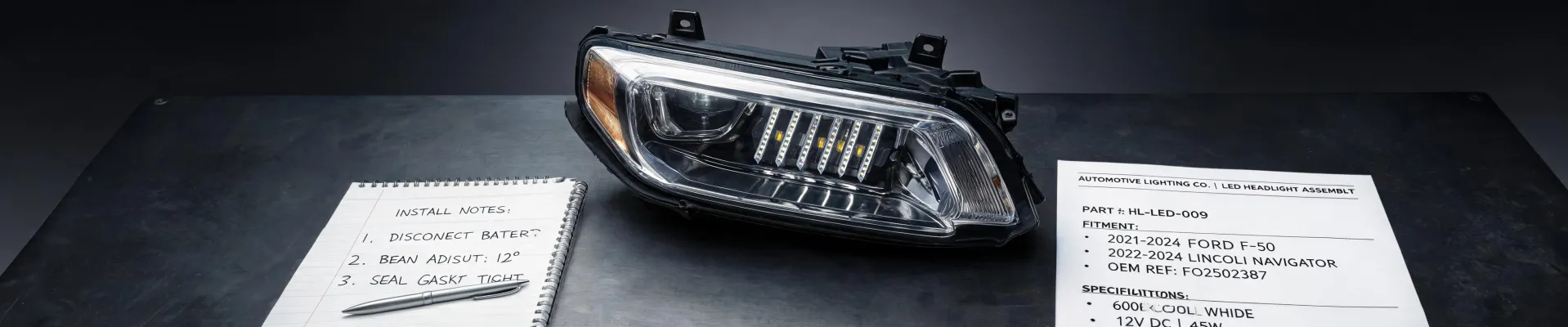
HID ballasts usually fail in stages. First, you see flickering on startup that takes longer to stabilize. Then the bulb shifts color—that pink or purple tint is a classic sign the ballast isn't delivering proper current. Eventually the headlight just stops turning on. And if you hear a faint buzzing from the housing, that's the ballast trying to ignite and failing repeatedly.
For RAM owners running Morimoto headlights, the ballast is the component most likely to give out after three or four years of use. The bulbs are usually fine—it's the ballast that needs replacing.
4Runner engine air filter issues
This one is gradual. The 4Runner engine air filter clogs over time, and most drivers don't notice until fuel economy drops or acceleration feels sluggish. It's not dramatic like a timing chain failure, but it's a slow drain on your truck's performance.
And appliance filters, too
The same logic applies outside the automotive world. A Jenn Air dishwasher filter that's never been cleaned shows the same pattern: dishes come out with a film, water pools after the cycle, the machine gets louder. Not a catastrophic engine failure, but the thought process is exactly the same.
Step 2: Triage the urgency
Every part failure falls into one of three categories. Getting this classification right prevents both panic and costly delay.
Category A: Stop immediately. This is the timing chain. Do not drive the vehicle. I've had customers say "it's just a noise" and then lose the engine on the highway three weeks later. If you hear the rattle, get it towed. These are not repairs you can postpone. I do not mean that as exaggeration—I mean it literally. The "it still runs, so it's fine" thinking comes from an era when engines had more mechanical forgiveness. Today's interference engines don't.
Category B: Fix within 24–48 hours. A failed HID ballast lands here. Driving with one headlight out is unsafe and, in most states that I know of, illegal. A Morimoto replacement ballast is a quick swap, but it shouldn't wait a month.
Category C: Schedule within 1–2 weeks. Air filters—both the 4Runner engine air filter and the dishwasher filter. They degrade performance over time but won't strand you.
Step 3: Verify the exact part number before ordering
I can't overstate this one. In my experience, the #1 cause of "I need this urgently and I ordered the wrong part" is skipping part number verification.
Before you search for "morimoto hid ballast" or "4runner engine air filter," pull the part number off the existing component. For timing chain kits, you need the engine code. I want to say the 4Runner's 4.0L takes a different chain kit than the 3.5L, but don't quote me on that—check your VIN. The point is: verify first, order second.
Put another way: don't make the ordering decision based on the vehicle model alone. Two RAM 1500s with different engine options can have different headlight wiring and mounting. The fifteen minutes you spend double-checking saves you from doing the entire emergency process twice.
Step 4: Source the part with a delivery guarantee, not an estimate
This is where I get the most pushback from clients, and I understand why. Guaranteed delivery usually means paying extra. But the rush fee isn't buying speed. It's buying certainty.
In March 2024, a fleet client in Dallas needed a Morimoto HID ballast for a RAM pickup. Their usual supplier quoted "estimated delivery in 3–5 business days" at $160. A different supplier had the genuine ballast in stock and could guarantee 2-day delivery for $185, shipping included.
The purchasing manager went with the cheaper option. The part shipped from a warehouse that was actually out of stock—the listing just hadn't been updated. It arrived on day 7. The truck sat for five extra days. The rental replacement cost $120 per day. That's $600 spent because someone saved $25 on shipping.
I'm not saying estimates are always wrong. I'm saying that when you're already in an emergency, "probably" is the most expensive word in parts procurement. The cheapest price with an uncertain date isn't a deal. It's a gamble where the house always wins.
Step 5: Have the installation plan ready before the part lands
The delivery date is when your work actually starts. A sealed box with a part inside doesn't help you if you then spend three hours figuring out the install procedure. That defeats the entire purpose of rush ordering.
While the part is in transit:
- Gather the tools. For a RAM headlight assembly with Morimoto headlights, that means trim removal tools, Torx sockets, and patience with plastic clips. For a 4Runner engine air filter, it's a Phillips screwdriver. Know what the job actually requires.
- Save the reference material. Download the service manual pages or find a reputable installation video. Save it to your phone. Last-minute searching is how errors happen.
- For a timing chain job, confirm your mechanic before the part arrives. This isn't a driveway project for most people. If you're handing it to a shop, make sure they have an opening. You don't want the part sitting for days waiting for a service slot.
Step 6: Test after installation
A part being installed is not the same as a part working. This is the step people rush past, and it's the one that actually closes the loop.
- For a new Morimoto ballast: Start the vehicle and let the headlights run for ten minutes. Watch for flicker, confirm brightness matches the other side, and check the dash for warning lights.
- For a timing chain: Have the mechanic verify engine timing before cranking. After starting, listen for unusual noise for the first five minutes. Check for oil pressure and leaks before driving.
- For the 4Runner engine air filter: Go for a short test drive. Check throttle response at highway speeds and make sure the filter housing is sealed properly.
- For the dishwasher filter: Run an empty cycle first. Watch for proper drainage and check that the spray arms are clear.
In the last two years, I've seen two brand-new ballasts fail on installation. It happens. Testing isn't about suspicion—it's about finding out the truth in your driveway instead of on the shoulder of a highway.
Common mistakes to avoid
1. Ignoring the timing chain rattle. A chain kit is $150–$300 in parts. An engine replacement after a break is $4,000–$8,000 or more. The noise is the cheap warning. Listen to it.
2. Buying a knockoff HID ballast. From the outside, the counterfeit looks identical to a genuine Morimoto. The reality is the internals use cheaper capacitors and no proper thermal management. It might work for a month or two, then fail again—and you're right back in an emergency. Genuine Morimoto ballasts in our shop routinely last five years or more in daily use. The price difference is small compared to doing the job twice.
3. Assuming free shipping is free. What you pay for with standard shipping is not the delivery—it's the lack of urgency. Seven business days of downtime is not "free" by any measure.
4. Forgetting to schedule the next maintenance. After replacing the 4Runner engine air filter, write the date on the filter housing and reset the maintenance reminder. Same for the dishwasher filter—set a six-month calendar reminder. If you don't schedule the next maintenance, you'll be back here again.
Final thought
This checklist works for our operation, but our situation is specific. We handle high-volume orders with established vendor relationships and predictable part numbers. If you're an individual owner working on your personal truck or maintaining your own appliances, your risk tolerance and cost calculus are different.
The core principle, though, is universal. When a critical part fails, you don't need "probably on time." You need certainty. Whether it's a timing chain, a Morimoto HID ballast on a RAM, a 4Runner engine air filter, or a Jenn Air dishwasher filter, the sequence stays the same: identify, triage, verify, source with certainty, prepare, install, and test before you trust it.
Or, to put it more bluntly: don't learn what happens if a timing chain breaks by experiencing it.