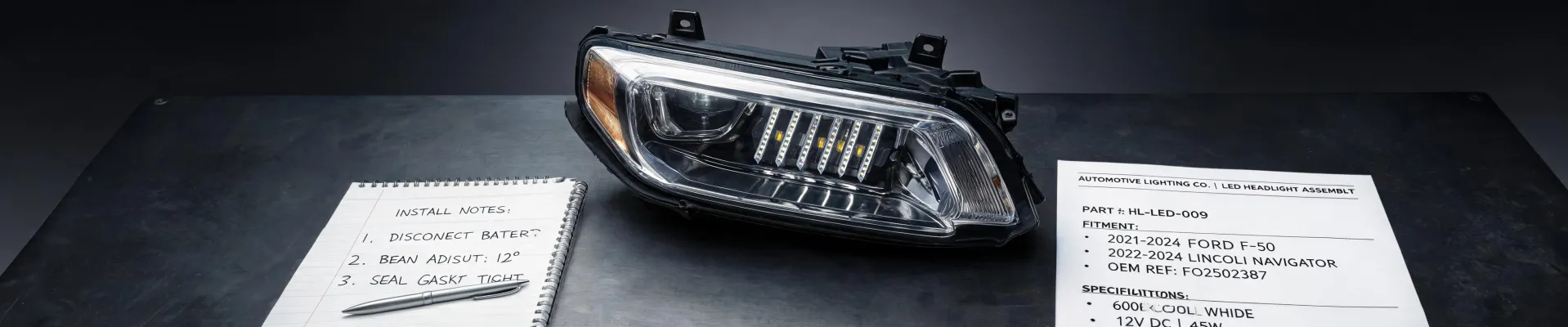
I coordinate parts for a repair shop that handles a lot of emergency work. I've expedited 300-something rush orders over the years—maybe 320? I'd have to check the log. And after all those hot calls, here's the opinion I'll defend: when a vehicle has to move on a deadline, you don't buy the cheapest part. You buy the part that will actually show up and work. That's why I spec Morimoto XB LED projector headlights on a Chevy 2500 without flinching. That's why I'd rather install a Mobil 1 oil filter on a Subaru Outback than something from a bin labeled 'universal.' And that's why, when a customer asks 'How much does it cost for spark plug replacement?,' my real answer is always: less than the next tow bill.
Certainty is part of the part
Lately, everyone wants to save money. I get it. Parts are expensive. But there's a difference between being smart with a budget and being cheap about the wrong things. A headlight that fogs up, an oil filter that collapses, a spark plug that misfires—these aren't random failures. They're decisions. The decision to save $20 at the worst possible moment.
In March 2024, a customer called at 2:30 PM. His Chevy 2500 had a broken headlight, and he needed to pull a loaded trailer out of state by 6 AM the next morning. The cheapest replacement housing we could find was in stock, but it would take two days to arrive. That didn't work. We ordered the Morimoto Chevy 2500 headlights, paid $85 for next-day freight, and had them installed and aimed by 8:30 that evening. He left on time. The extra $85 bought a $1,700 hauling gig. Done.
What most people don't realize is that a headlight housing's job isn't just to look like one. It's to control a beam pattern. Cheap housings use cheap reflectors. They can look fine in a driveway and fail on a dark back road. Morimoto XB LED projector headlights don't just house a bright bulb—they're actual projectors. That's a different engineering category. It's the difference between guessing where the light goes and aiming it with intent.
Oil filters: The cheapest part to change, the easiest one to skip
People think oil filters are all the same. They're not. Here's something vendors won't tell you: a $7 filter and a $14 filter often have the exact same outside dimensions. Cut them open and you'll see different media, different bypass valves, and different anti-drainback valves. On a Subaru Outback, those details matter. The filter sits in a spot where drain-back can leave the top end dry on a cold start. A filter with a weak anti-drainback valve means metal-on-metal for a few seconds. Why does that matter? Because an engine has to survive thousands of cold starts, not just one. A Mobil 1 oil filter isn't magic, but it's consistent. That consistency is the point.
If you're due for a Subaru Outback oil filter change, don't hand a technician a mystery filter from the trunk. Use one you can identify. Based on January 2025 pricing, a Mobil 1 oil filter runs around $10 to $16 at most retailers. The engine rebuild you avoid is the real price difference.
Spark plug replacement: It's not the quote that hurts
Every month, someone asks me, 'How much does it cost for spark plug replacement?' The honest estimate: on a four-cylinder car, around $150 to $300. On a V8 truck or something with coils buried in impossible places, $300 to $500. Those figures are based on national shop quotes from January 2025; verify current pricing. But that's almost the wrong question. The real cost of spark plug replacement is what happens when you skip it. A worn plug causes a misfire. A misfire kills a coil. The overheated catalytic converter is where the real money goes. A $45 job becomes a $1,200 repair. I've seen it happen exactly 14 times in the last three years. I started keeping count after the third one.
Think about what that means. The reason you ask 'how much does it cost for spark plug replacement' is to budget for maintenance. But the budget question only makes sense if you include the cost of not doing it. The cheapest spark plug is the one that costs you a tow truck and a weekend.
Why premium parts cost more (and why that's okay)
People think premium parts cost more because of the logo. It's actually the reverse. The logo costs more because the part is made to tighter tolerances. Morimoto spends money on tooling, testing, and output specs. That's why their XB line performs consistently. The brand is a marker, not the cause.
Same with Mobil 1. Mobil 1 doesn't charge more for the filter because they can. They charge more because the materials and testing cost more. If you need proof, buy a cheap filter and a Mobil 1 filter. Cut both open. That test turns people into believers.
The same principle applies to any part with a real spec. A cheap part might pass a visual inspection. It won't pass an engineering review. That's the difference between a part that works in a parking lot and a part that works at 70 miles per hour when you need it.
But I've used cheap parts and they worked
I can hear the pushback: 'I put a cheap headlight in my truck and it still works.' Fine. If you're driving around town and can wait a few days for a replacement, that's a risk you can take. But if your vehicle is a tool—a Chevy 2500 that gets paid by the mile, or a Subaru Outback that carries your family through winter—then uncertainty isn't a budget category. The guarantee of arriving on time is worth more than the difference between a seven-dollar filter and a fourteen-dollar filter. That's kinda the point: certainty is part of the part.
I'm not saying you should blindly buy the most expensive thing on the shelf. I do not mean that at all. I'm saying you should pay for evidence. Get a quote that includes a real spark plug replacement cost instead of a guess. Check the part number. Ask if the headlight has an output test. Put another way: a plan that depends on luck isn't a plan.
There's something satisfying about a job done right the first time. After the stress of an urgent repair, seeing a customer leave with clean, properly aimed headlights and a fresh oil filter is the payoff. That's what certainty feels like. It's not a luxury. It's a tool. And when your timeline matters, it's the cheapest tool you'll buy.