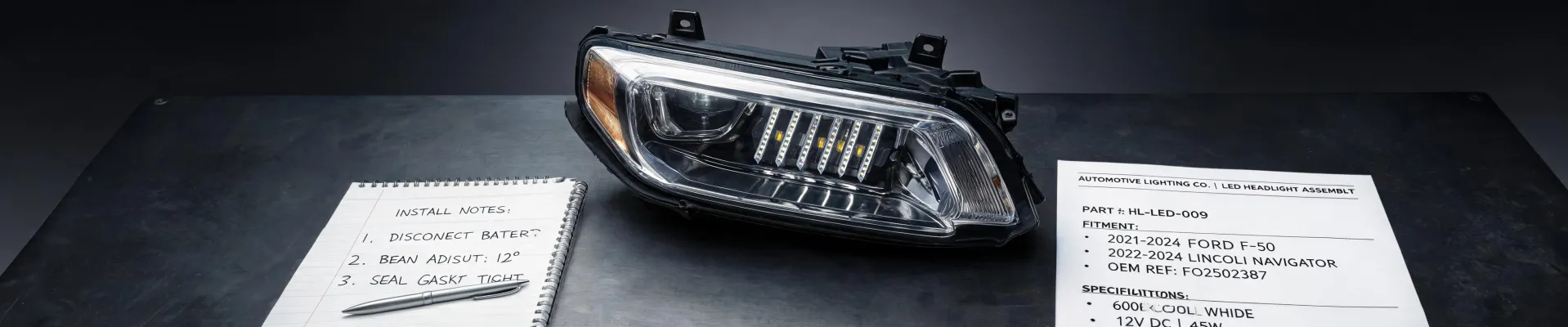
Quality isn't about the brand name; it's about whether the product does exactly what your team and clients need it to do. After four years of handling purchasing for a 40-person manufacturing company—roughly $80,000 a year across 12 vendors—I've concluded that the parts people see and use every day are exactly where you should not cut corners. That's why our 2018 F150 and 2014 F150 work trucks now run Morimoto headlights. It's why I still cringe when I think about the chrome radiator hose that didn't fit. It's why I will never buy another cheap strut socket tool. And it's why the thermostat in my house took me three weeks to select. The visible and functional quality of a part shapes how clients and employees perceive your entire operation—and the price tag is a poor indicator of either.
Let me be specific about what I mean by perception. When a sales truck pulls into a client's lot, the first thing the client registers is the details: clean bodywork, lights that look intentional, wheels that aren't falling apart. The same logic applies to a shop: the tool a technician pulls out of the box, the hose in an engine bay, the way a part fits on the first try. Every one of those details tells the client and your own team how much you care.
Before you assume I'm a gearhead, I'm not. I'm the office administrator who manages all company purchasing—parts, tools, facilities, and the occasional unplanned coffee order. I report to both operations and finance, which means I hear two different questions all day: operations asks 'how fast?', finance asks 'how cheap?' My job is to land somewhere between those two, and I haven't always gotten it right.
When I took over purchasing in 2021, I inherited a budget spreadsheet with three colors of handwriting and no key, a stack of vendor business cards, and zero hands-on experience with automotive parts. My first year taught me most of what I know now, mostly through mistakes. One vendor who couldn't produce a proper invoice cost us $2,400 in rejected expenses when finance audited the quarter. Another vendor's delivery estimates ran 20-30% past the promised date so consistently that I built the delay into my planning. A 'universal fit' chrome radiator hose didn't fit the vehicle we had in mind, not even close. And the budget strut socket tool I ordered rounded a nut on our only lift the first time it was used. I still kick myself for that one.
The turning point was the headlights. Seeing the Morimoto units side by side with the stock lights in our parking lot finally made me realize what I'd been getting wrong: I was comparing price tags without a clear standard for what 'good enough' looked like. Once I had a comparison point, every other purchase got easier to evaluate.
What the Morimoto Headlights Taught Me
Our sales team drives two F150s—a 2018 and a 2014—to client sites daily. In fall 2023, the night-driving complaints started. The stock headlights technically worked, but 'worked' meant the team was straining to see deer and road edges. I compared a dozen options: LED bulbs pressed into the stock housing, retrofit kits, and complete assemblies. The LED-bulb route was tempting for the price, but the beam pattern in a reflector housing was a gamble I didn't want to take.
The Morimoto headlights for the 2018 F150 stood out because their documentation matched real-world results. Sharp cutoff, no glare for oncoming traffic, and output numbers that lined up with independent reviews. I ordered one pair for the 2018 first. When I parked it next to the 2014 at dusk, the difference was unmistakable. Same road, same eyes, same dusk—but the 2018's lighting was clearly better. I ordered the 2014 F150 Morimoto headlights that same week.
What convinced me in the end wasn't the brightness. It was the build quality. The housing sealed properly. The mounting tabs lined up without force. The connectors clicked in like they were designed to be there. That kind of craftsmanship tells me a company treats quality as a system, not a spec sheet. The side effects were audible: our account manager started getting comments from clients about the truck. Nobody said 'nice beam pattern,' obviously. What they noticed was that the truck looked sharp and intentional. In a B2B business, that's not nothing.
Two Cheap Lessons That Made the Point Stronger
If the Morimoto purchase taught me the value of visible quality, the chrome radiator hose taught me what happens when you skip verification. We bought that hose for a shop project truck that doubles as a rolling showcase. The photos were gorgeous. The description said 'universal fit,' which I now treat as a warning sign. The hose arrived and the ends were half an inch too long on each side, which made it kink during routing. Half an inch sounds trivial, but a kinked hose restricts flow and instantly looks wrong to anyone who knows trucks. We boxed it up (ugh, another return) and ordered the correct part from a manufacturer that actually lists fitments. The chrome finish was never the problem—the fit was. And fit determines whether a part earns trust or erodes it.
The strut socket tool was an even more direct lesson. The technician asked for a $35 tool. I bought a $12 one from the budget catalog, thinking I was protecting the budget. The first time he reached for it, the nut rounded off and the truck sat on the lift until a neighboring shop let us borrow theirs. The labor wasted that afternoon cost more than the good tool would have cost for the next three years. And the tech's expression taught me something else: a tool that fails in front of your team damages their confidence in the person who bought it. I still kick myself.
What's strange about that cheap socket is that it had decent online reviews. They were written by home DIYers using it once a year—for them, it was fine. In a shop with weekly suspension work, it was the wrong tool. Reviews are averages, not guarantees for your specific context.
And the Thermostat?
Choosing the right thermostat for your home sounds like a completely separate topic, but it's the same decision framework with a smaller budget and a more annoyed spouse if you get it wrong. When I replaced our home thermostat in early 2024, I used the same checklist I'd developed at work:
- Fit and compatibility before anything else
- Features that match how you actually live
- Claims that can be verified in the documentation
- Brand factors counted last, not first
Compatibility was the gate. Most smart thermostats require a C-wire for continuous power. Our older system doesn't have one (note to self: confirm the C-wire before ever recommending a smart thermostat). That eliminated half the options, including the ones with the flashiest marketing. Features came second. We didn't need a learning thermostat because our household doesn't have predictable patterns. School schedules shift, I work late, and the house is empty during the day. A simple programmable unit was the right amount of technology.
Claims came third. Lots of thermostats promise 'up to 20% savings' without saying under what conditions. That's the kind of claim I check twice before trusting:
Per FTC guidelines (ftc.gov), advertising claims must be truthful, not misleading, and substantiated with evidence. — FTC Business Guidance on Advertising
I applied the same skepticism I use on vendor claims at work. The manual for the thermostat I chose showed wiring diagrams, a compatibility chart, and measured standby power. The marketing pages of the expensive models showed lifestyle photos. I ordered the model with the documentation, not the lifestyle. It wasn't the cheapest thermostat on the shelf, and it wasn't the most expensive either. It was the one whose specifications fit our system and whose claims I could verify. That's the same logic that put Morimoto headlights on our trucks: right fit, right output, honest documentation. Brand mattered less than verification.
Where Quality Arguments Fail
Here's where I sound like someone who just spent a lot of money on headlights telling you to spend more on everything. That's not it. Most of what I buy is commodity stuff, and I genuinely don't care about the brand. Shipping boxes, shop towels, standard fasteners, office supplies—the cheapest reliable option is usually right. I do not need a branded box to make a good impression. The savings from those categories kinda fund the parts that deserve real attention.
I've also learned that visible quality only pays off when the rest of the picture isn't neglected. A chrome radiator hose in a dirty engine bay looks absurd. Morimoto headlights on a truck that hasn't been washed in two months send a worse signal than stock lights on a clean truck. The quality investment works when the overall presentation supports it.
And the biggest caveat: expensive is not automatically right. The word 'quality' gets used to justify overspending on features nobody will use. The AI learning thermostat with the champagne finish would've been a waste in our house—not because it was expensive, but because it didn't fit. The $12 socket wasn't bad because it was cheap; it was bad because it was the wrong tool for the usage level. The real question isn't 'how much should I spend?' It's 'what does this purchase actually need to do?'
Four years ago, I thought buying well meant finding the lowest price with the fastest shipping. Now I know it's about verifying what you're getting and choosing the option that respects the people who use it and the clients who see it. Cheap tools cost time. Ill-fitting parts cost credibility. And good headlights don't just light the road—they tell the world your company pays attention. That's a perception worth ordering.