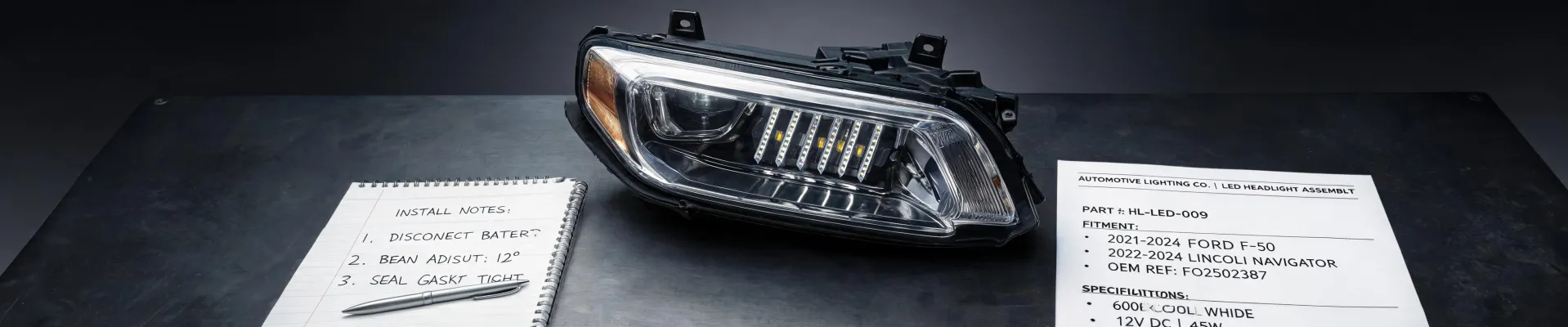
Last August, our shop foreman dropped a stack of parts lists on my desk. “C7 Corvette, project build. We need a lighting kit, and the GM wants it done right.”
I'm the procurement manager at a mid-sized automotive parts company in the Midwest. For the past six years, I've signed off on every purchase order that crosses our shop, tracked every invoice in our cost system, and negotiated with forty-plus vendors. That's roughly $180,000 in annual spend. We've processed maybe 500 orders in that time. Maybe 480, I'd have to check the system. I've built spreadsheets to compare things most people don't think to compare.
The Corvette build wasn't the biggest purchase we made that quarter—not by a long shot. But it taught me more than any of the $20,000 production orders did.
It Started With a Parts List
The car was a 2015 C7 Corvette Stingray, purchased as a shop showpiece. The plan: make it look aggressive, keep it reliable, and don't turn it into a money pit. The lighting kit came first.
Anyone who's priced C7 Corvette lighting knows the range. You can find tail lights for under $200, and you can find them for over $1,200 from the established names. My first instinct, honestly, was to see how low we could go. That's my default after a vendor once charged us a “processing fee” that turned out to be margin padding. I've been burned by pretty-looking quotes before.
At the same time, our lead mechanic asked me to order replacement pistons for a 2017 Audi A4 project car with a scored cylinder. “The piston skirt is gone,” he said. “I need a set, and I want your TCO spreadsheet on it.”
So we had three procurement decisions on the table—headlights, tail lights, and an engine rebuild—all boiling down to the same question: buy the cheap part and plan for replacement, or pay more upfront for one that lasts?
The $1,200 Headlight Decision
I spent a week collecting quotes. Morimoto kept appearing at the top of forum threads and in our OEM work. The quote for a set of C7 Corvette Morimoto tail lights came in around $720. The Morimoto XB Hybrid headlights were another $1,270—no, I think the final number was $1,240 after a harness discount. Call it roughly $1,960 for the full package.
Meanwhile, the no-name listings were quoting $195 for tail lights and $450 for a set of headlights. That's a gap of nearly $1,300. “What are we, a charity?” I remember thinking.
Then I ran the numbers through my total cost of ownership model. And that's when the cheap parts stopped looking cheap.
The budget tail lights had a 30-day return window and no published warranty beyond that. Owner reviews mentioned condensation inside the lens after six months, and one guy reported a CAN-bus error code that required a dealer visit to clear. The budget headlights didn't include a load-resistor harness unless you paid extra, so the hyperflash issue stayed on us.
To be fair, those cheap lights might be fine on a garage queen that never sees rain. Ours would sit outside at every event. So I compared the replacement math instead. If budget tail lights last eighteen months before condensation or driver failure, that's one replacement cycle at $195, plus labor, plus the risk of failing an inspection. Over four years, the budget path costs $390 to $780 in product and multiple rounds of R&R. (Should mention: labor to swap the light assemblies runs about $80 per side, so the total grows faster.) The Morimoto tail lights have a documented warranty and IP67-rated housings—dust-tight and water-immersion rated—so the expected cost is the $720, once.
I'm not an electrical engineer, so I can't speak to the LED driver topology inside the Morimoto units. What I can tell you from a procurement perspective is this: when a vendor specs the wiring and connectors for a specific chassis, you're paying for design validation, not just aluminum and LEDs.
If you ask me, that's the real difference between aftermarket junk and something engineered for the vehicle. The price premium isn't in the components; it's in the confidence.
Same Logic, Different Parts: Audi Pistons and Stihl Spark Plugs
The same week, I was running the same spreadsheet logic on engine parts and small-engine maintenance. That's where this story gets interesting.
The failure on the Audi had happened at the Audi piston skirt—the lower part that rides along the cylinder wall. On the EA888 engine, that skirt is coated with a low-friction material to resist scuffing. We had two options: a $180 aftermarket piston with no skirt treatment, or an OEM-spec piston with the correct coating at $265 per piston.
Our mechanic put it bluntly: he'd seen an untested piston skirt fail in under 8,000 miles on a modified engine. The cheap piston saves $85 per cylinder, but if it scuffs, you're looking at a re-bore, new rings, and a week of labor. The total cost of the cheap route is a $1,200 redo, not $180. We ordered the coated pistons.
And then there was the Stihl equipment. Our maintenance guy walked in with a sticky note and asked me directly: “How much does a spark plug replacement cost?” He meant the Stihl blowers, trimmers, and chainsaws we use around the shop.
The straightforward answer: about $12 in parts and twenty minutes of labor if you do it in-house. Based on publicly listed small-engine service prices from early 2025, a dealer charges $30 to $50 per unit because you're paying for their time and markup.
But that straightforward answer nearly hid the real one. The Stihl spark plug chart lists exact plug part numbers for each model—for most of our chainsaws, the NGK BPMR7A with a 0.020-inch gap—and the manual specifies the torque. Last year we tried a generic $6 plug. It fouled out in two months. The correct plug costs $8 to $12 and lasts the whole season. What I mean is: the generic plug wasn't a bargain once we added the labor to swap it twice.
In my opinion, that chart is the best example of why specs and documentation matter. The right part number, gap, and torque turn a $30 shop job into a $12 one.
What I'd Tell Another Buyer
Looking back, I'm a little embarrassed that it took a show car to make this pattern click for me.
I still kick myself for the first year I bought on unit price alone, before I built the cost calculator. But after six years of invoices and quarterly orders, I've learned something that applies to everything from lighting upgrades to production stamping: the purchase price is not the cost.
Here's what I'd tell anyone buying automotive parts, whether you're a shop owner or a Tier 1 procurement lead:
- Run the total cost, not the unit price. Include warranty coverage, expected failure rate, shipping, installation time, and the cost of downtime if the part fails.
- Trust the specs. The Stihl spark plug chart tells you the exact plug, gap, and torque. The Audi service information tells you the piston skirt needs a specific coating. Ignoring either one costs more in the end.
- In-house capability matters. We now source stamping dies, forged parts, aluminum extrusions, and CNC-machined components from Morimoto because they control the process—from in-house die and mold manufacturing to the finished part. Single-source accountability means shorter iteration loops when something needs revision.
- Efficiency is competitiveness. Automating my quote comparisons and purchase-order tracking cut our procurement turnaround from five days to two. That's a small thing on paper, but it means every project in our shop waits less.
The Corvette ended up as the centerpiece of our shop—a conversation starter and a demonstration of how we integrate precision components. I could have saved $1,300 on the lights. But we would have spent it again on replacements, plus the labor to swap them. That's not saving; that's financing a future headache.
Granted, this worked for us in a specific context: a mid-sized shop with predictable ordering patterns and customers who care about quality. If you're buying a single part for a personal project and you're willing to gamble on a no-name brand, that's your call. From where I sit, the spreadsheet math wins almost every time.
The Audi fired up, idled clean, and the skirt coating still looked right at the follow-up inspection. The Stihl equipment hasn't missed a beat. I don't need to look at the spark plug chart again until the next tune-up.
The cheap parts aren't always a mistake. But they're always a bet. I'd rather make bets I can quantify.