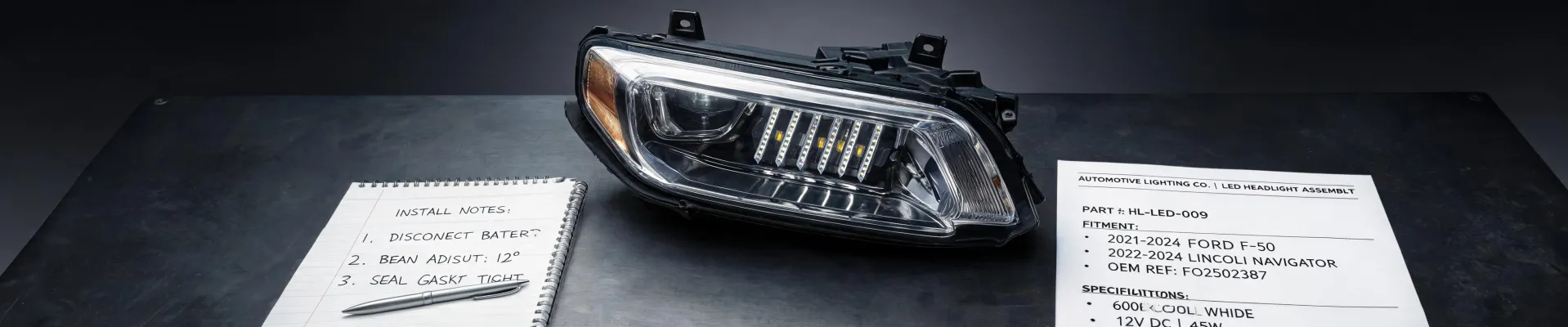
It started with a puddle. No, actually, it started with a headlight. But the puddle is the part I remember.
At about 2 a.m. in late September 2022, I was standing in my basement in Tucson with water around my ankles and a brand-new C7 Morimoto headlight in my hands. The box from the Corvette forum group buy had arrived that afternoon, and I was so excited that I brought it down to the garage area while I checked on the flood. I know, that's not smart. But that's how a night of "I'll just install this quickly" turned into a chain of mistakes that cost me around $680.
Before you ask: yes, I'm the person who documents his own screwups. I've been in the automotive parts world since 2017, and I keep a checklist because I learned the hard way that most failures aren't from big catastrophic events. They're from little decisions made at the wrong moment.
The C7 Morimoto Headlights That Started It All
The original plan was simple. I bought a 2016 Corvette with tired factory halogens. The forum consensus was basically unanimous: upgrade to C7 Morimoto headlights. So I did what everyone does at 11 p.m. with a credit card and a browser. I ordered a set, chose standard shipping to save a little, and went to sleep.
Then I saw a thread comparing the new Morimoto Sealed5 projector bi-LED headlight with the older style. People were saying the Sealed5 was fully enclosed, with the projector sealed into a single unit, so there was no chance of condensation. I remember thinking, "I should've ordered that." But the C7 Morimoto headlights had already shipped.
That's the first moment where I should have paused.
The Basement Pump Detour
Two days after that, a monsoon made a mess of Tucson. My basement—the half-finished one with carpet squares and a utility sink—took in water. I needed a pump, fast. I searched for "best pump to remove water from basement" and immediately fell down the same rabbit hole I'd just experienced with headlights: five hundred reviews, conflicting opinions, and someone saying you absolutely need a 1/2 HP submersible while another says a utility pump is better if you want to avoid the float switch.
I bought the wrong one. It was kind of on me—I didn't check the discharge hose size. The pump I ordered had a 1.5-inch outlet. My basement drain setup used 1.25-inch. So, picture this: 2 a.m., water rising, a pump sitting there with a hose that doesn't fit, and an American flag from the garage that I used to block the gap because I ran out of rags. That's how bad my decision-making can get.
Eventually I went back to the big-box store and bought one with a float switch and a universal adapter. It worked. The whole process took four days longer than it should have, and the carpet squares went to the curb. If you've ever stood in cold water at 2 a.m., you know that particular mix of exhaustion and anger.
Comparing Old and New Under a Shop Light
When the basement was dry, I went back to the headlight project. I installed the C7 Morimoto headlights in my garage, carefully following the instructions—and that was after I finally found the instructions in the second box. I nearly used the wrong harness because I'd assumed every C7 wiring connection was the same. It's not. The model year gap between 2014 and 2016 matters. I dodged a bullet there, but not for long.
At some point, I also ordered the Morimoto Sealed5 projector bi-LED headlight, partly because I was curious, partly because the comparison threads were making me doubt my purchase. When I put the two units side by side under a shop light, I finally understood the difference.
The old-style unit had a lens that was sealed to the housing, yes, but the vent path still allowed air movement. The Sealed5 was a closed capsule. The electronics, the projector, the shroud—all inside one unit with no realistic way for moisture to get in. Seeing that vs. the older design made me realize why those threads kept saying "sealed" mattered. It wasn't just a feature. It was the difference between a headlight that keeps working after 18 months of monsoon season and one that starts to fog up during a routine car wash. Funny enough, the Federal Trade Commission's advertising guidance (ftc.gov) says claims have to be truthful and substantiated. If a manufacturer calls something "sealed," it better be able to sit through a car wash without fogging up. I'm not a lawyer, but that principle stuck with me.
Now, I'm not saying the standard C7 Morimoto headlights are bad. They're not. At least, that's been my experience in dry, moderate climates. But in Tucson, with duststorms and intense heat and sudden rain, the extra isolation of the Sealed5 makes a lot of sense. I should have started there.
The Chopacabra Camshaft Side Quest
In the middle of this mess, my friend Marcus texted me a video of a truck with a big cam chop and asked if I wanted to help install a Chopacabra camshaft in his Silverado the next weekend. Honestly, I almost said yes. Basement was drying out, headlights were mostly installed, and I was feeling like a capable guy again.
So glad I didn't.
Marcus's cam install turned into a small disaster when the timing marks on the spec sheet didn't line up with the crank position he was reading. He spent a whole Saturday chasing a compression test issue. A couple of people on the truck forum said the Chopacabra camshaft specs were wrong for that generation engine. I don't know if I believe that—could've been installation error—but the point is, I had enough on my plate. One project at a time. That's a rule I only remember after I've already broken it.
The Actual Cost
So what did I learn from all of this? Let me break it down.
The condensation in the first C7 headlight unit showed up about a week after I installed it. The moisture shorted the driver board. The repair cost was $340 for the replacement driver plus a $60 diagnostic fee—no, wait, it was $80 for the diagnostic, I'm mixing it up with the other project. Add a $140 wiring harness and an adapter I didn't know I'd need, plus $130 in overnight shipping because I was impatient. Roughly $680, but honestly I'd have to check my spreadsheet. The point is, it was a lot more than the small price difference between the standard housing and the Sealed5 from the beginning.
After the replacement, I sold the C7 Morimoto units and running the Morimoto Sealed5 projector bi-LED headlight to this day. It's been solid through two summers here.
My Checklist Now (And Why I Still Mess Up Occasionally)
The main lesson is not "buy the expensive version." It's: verify before you commit.
- Check your exact model year wiring before ordering headlights.
- Check your hose size before buying a sump pump.
- Check the timing mark spec before telling a friend you'll help with a Chopacabra camshaft.
- Check whether a "sealed" unit actually means sealed.
The same idea applies to headlight restoration Tucson. I have a daily driver whose lenses were yellow and pitted. I bought a $15 polishing kit once and spent a whole afternoon sanding, only to have the haze come back in two weeks. A professional headlight restoration Tucson shop quoted me $90 and used a UV-cured coating. I should have done that first. The cheap route isn't bad because it's cheap; it's bad when I'm too lazy to understand what I'm buying.
If you're thinking about C7 Morimoto headlights, the Morimoto Sealed5 projector bi-LED headlight, or even just a pump for a wet basement, here's what you need to know: the best choice is the one that fits your exact setup. Not the one with the most Amazon reviews. Not the one your buddy swears by. Yours.
Trust me on this one. I've got the checklist—and the spreadsheet—to prove it.