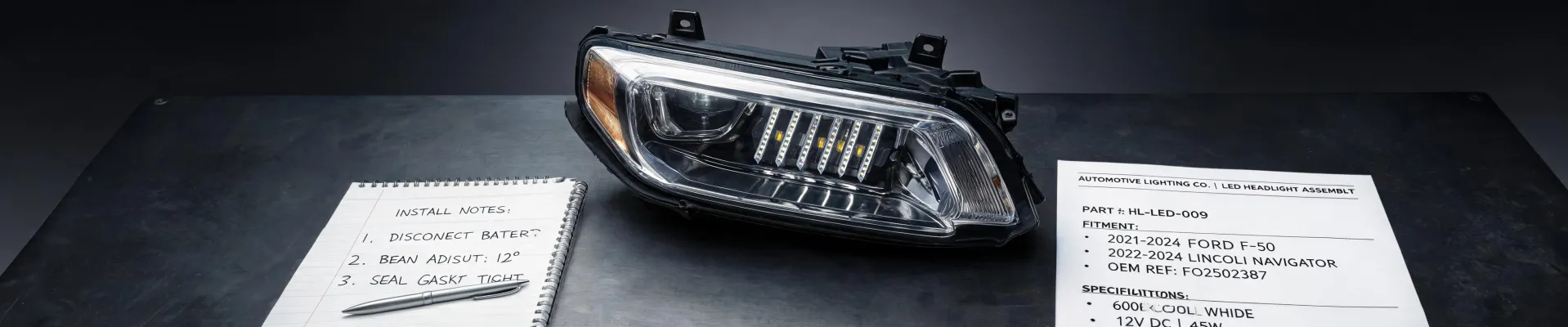
When I took over purchasing in 2020, I thought I had a handle on how to compare vendors. You get three quotes, pick the middle one, and move on. Simple, right? Then I had to source replacement lighting for a fleet vehicle, and the options were roughly split between Morimoto and a few cheaper aftermarket brands. It took me about four years and a couple of expensive re-orders to understand that the real comparison isn't just price—it's the total cost of everything that happens after the order is placed.
What I'm going to do here is break down the comparison between a premium brand like Morimoto and generic aftermarket parts across three real-world dimensions: fit and finish reliability, installation and downtime, and long-term warranty exposure. This isn't about which one is 'better' in a vacuum—it's about which one costs less when you factor in your time, your reputation, and the risk of doing it twice.
Why This Comparison Matters (and What You’re Really Buying)
Most people see a price tag and a product image. They assume the $400 part and the $150 part serve the same function. What most people don't realize is that the 'function' of a car part—especially something like a headlight assembly—includes things like sealing against moisture, matching the connector pin-out exactly, and lasting more than two Midwest winters. I'm not 100% sure how much variance there is in the supply chain for counterfeit bulbs, but I've seen enough to know the gap is wider than you'd think.
So the real question isn't 'Which is cheaper?' It's 'Which one is cheaper to own?' Let me walk you through how I compare them now.
Dimension 1: Fit, Finish, and the 'Plug-and-Play' Promise
This is where I've seen the biggest divergence. Morimoto parts usually come with a detailed fitment guide and a specific harness. The aftermarket part arrives in a box that looks vaguely like a well-known brand's packaging, but with slightly different spelling. The first test is visual. The second test is physical installation.
Morimoto: In my experience, the housings are injection-molded to a tighter tolerance. The mounting brackets line up without having to file anything down. The connectors click in. If I remember correctly, one Tacoma headlight install I oversaw took a tech about 45 minutes. The part was a direct replacement. No surprises.
Generic Aftermarket: More often than not, the first sign of trouble is a gap. Maybe it's 2mm, but it's there. Then the wiring harness—which is supposedly 'direct fit'—doesn't quite reach the factory plug on the passenger side. You have to splice. That's where the clock starts ticking. That simple install now takes an hour and a half. Or it might need a bracket adapter that wasn't in the box. Not ideal, but workable.
The conclusion here is pretty clear: Morimoto wins on fitment reliability. If your time is worth anything, paying for that certainty is often cheaper than troubleshooting a generic part on the install bay floor.
Dimension 2: Installation Time, Downtime, and the Hidden Labor Cost
This is the dimension that shifted my entire view on procurement. I used to look at the unit price. Now I look at the hourly rate of the guy installing it.
Let's say a tech costs the shop $50/hour in fully loaded labor. If a generic part takes an extra hour to install (due to fitment issues), that's $50 you didn't account for. If the part also comes with instructions that are essentially a photocopy of a photocopy, maybe you lose another 20 minutes troubleshooting. That's the cost I wasn't seeing on the original invoice. I want to say we ordered about 120 units of a certain aftermarket light over the last three years, but don't quote me on that—I'm mixing it up with part numbers from a different project.
Three things: the part cost, the labor to install it, and—critically—the labor to fix it if it fails. The $150 part that takes 2 hours to install? That's really a $250 part. The $400 Morimoto part that takes 45 minutes? That's a $437 part. The gap narrows fast.
The conclusion? After figuring in labor, Morimoto's cost disadvantage shrinks significantly. For high-volume or high-utilization shops, this is the key metric.
Dimension 3: Longevity, Warranty, and the 'Do It Twice' Tax
This is where the aftermarket option sometimes falls apart (literally). I've had a generically-branded headlight assembly develop condensation after 18 months. The claim process was a nightmare. The vendor who couldn't provide proper invoicing cost us $2,400 in rejected expenses on a related project, so I'm especially sensitive to this now. The 'warranty' on the aftermarket part was only honored once we provided a receipt (which we luckily had) and photos. It took three weeks to get a replacement. Meanwhile, the vehicle was down.
In comparison, I've found Morimoto parts to hold up better to weather and UV exposure. That's partially because they use a better UV coating on the polycarbonate lens—an industry standard that cheaper suppliers often skip. The inside info here is that 'standard' lens coating isn't always the same. Some corners get cut.
Morimoto: Higher upfront cost, but significantly lower risk of premature failure. If a part is supposed to last five years, and it fails in two, you've effectively paid double the 'annual cost' plus the labor to replace it.
Generic: Lower upfront cost, higher probability of early failure. A lesson learned the hard way. Even after choosing a new supplier for a batch of aftermarket lights, I kept second-guessing. What if the quality wasn't as good as the samples? The two weeks until the first shipment arrived were stressful.
The conclusion is counterintuitive: The cheapest part often has the highest TCO over a 3-5 year lifecycle. Morimoto's longevity makes it the less expensive option in the long run for a fleet or a high-mileage application.
My Two Cents: When to Choose Which
I don't believe there's a one-size-fits-all answer here. Here’s how I break it down for our procurement decisions:
Choose Morimoto (or equivalent premium OEM-grade) when:
- Downtime is expensive. A vehicle that needs to be on the road now can't wait for a warranty replacement.
- The installation is time-sensitive. You want a 45-minute job, not a 2-hour puzzle.
- The vehicle will be kept long-term. The TCO equation heavily favors durability over 3+ years.
- The specs are performance-critical. For lighting, this means beam pattern and safety.
Consider aftermarket (or budget-friendly options) when:
- The vehicle is near end-of-life or about to be sold. You just need something that works for 12 months.
- The cost difference is so extreme that you can buy two spares.
- Installation is simple and you handle it in-house with slack labor.
Take this with a grain of salt: these rules of thumb change based on the specific part. A tb110 spark plug is a different beast than a headlight housing. For complex assemblies like morimoto xb headlights tacoma, the build quality difference is more pronounced than for a simple plug. And if you're tackling a best way to clean dpf filter, that's a whole different maintenance conversation.
In the end, comparing Morimoto to a generic brand isn't about patriotism or brand loyalty. It's about understanding that the price on the quote is just the entry ticket. The real cost is the sum of your time, your trouble, and the risk of doing it all over again. That perspective turned me from a price shopper into a cost manager.