-
Are the 4Runner Morimoto headlights worth the premium?
-
Are the 2013 Ford F150 Morimoto headlights easy to install?
-
How long does fuel pump installation really take?
-
Which alternator should I get for a Honda Odyssey?
-
How much to replace exhaust pipe?
-
What's the difference between OEM and aftermarket—when it isn't a difference?
I'm a quality compliance manager at an automotive parts manufacturer. Every week, I review components before they clear our shipping dock—roughly 200 unique parts a year. Along the way, I've accumulated strong opinions about what's worth paying for and what isn't. It took me about three years and hundreds of returned parts to understand that what fails first is rarely what you paid the most attention to at purchase.
Here are the questions I get asked most often, answered the same way I'd talk to a friend who owns a ten-year-old vehicle and wants to keep it alive.
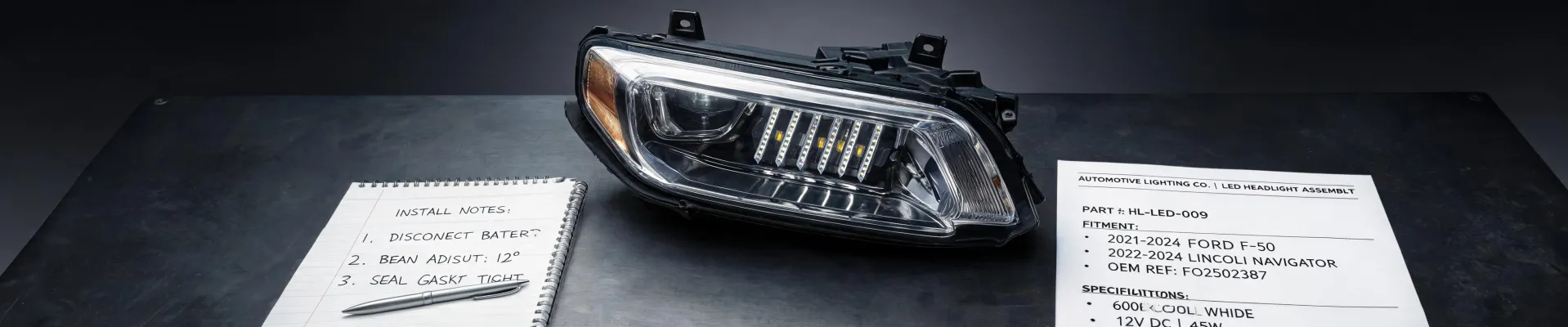
Are the 4Runner Morimoto headlights worth the premium?
The short answer: yes, for most people who plan to keep their 4Runner. But the reason isn't what most buyers expect.
The stock projector on the 4Runner is dated. Its cutoff isn't terrible, but the overall light output is mediocre. The 4Runner Morimoto headlights fix that with a genuinely sharp cutoff and a broad, even beam pattern. When we bench-test headlights, we check for beam scatter—cheap LED units tend to have bright spots that don't translate into actual usable distance. The Morimoto projectors don't have that problem.
Per FMVSS 108, the federal lighting standard, headlamps must meet photometric requirements for beam pattern and cutoff. A cheap retrofit can look impressive in a parking lot, then fail the glare test on the road.
What separates good headlights from knockoffs, though, isn't something you notice in the first month. It's the seal and venting. After a couple of years, moisture intrusion is the #1 failure I see across aftermarket headlights. The budget units I've inspected—and returned to vendors, because I have a desk full of failure photos—have weaker gasket compression and minimal venting. A headlight that fogs up from the inside is a $250 paperweight once the warranty lapses.
Installation matters too. Rushing the bracket mounting, snapping the harness clip, or skipping the aim adjustment turns a good headlight into a mediocre one. Take the extra time.
Are the 2013 Ford F150 Morimoto headlights easy to install?
That specific model has some quirks. I've reviewed return data on 2013 F-150 Morimoto headlight installs, and most problems trace back to fitment steps where people rush.
The classic issue: the aluminum projector bracket has four screws that need to be torqued evenly, in sequence. I watched an install video once where the guy tightened them one at a time, fully. When he hit a bump, his beam aimed at the trees. He blamed the headlight; the math said otherwise.
Another gotcha—the adapter harness clip on the driver's side. It's easy to seat it wrong because the wiring bundle in that year sits tight against the fender liner. If I remember correctly, Morimoto's install guide flags this specifically. I'd recommend reading it before you start, not halfway through.
Oh, and do a test fit before reassembling the bumper. Yeah, it takes an extra 20 minutes. In my first year, I skipped the test fit on a lighting assembly because "it's basically the same as last time." It wasn't. The customer came back, I spent a Saturday fixing my own mistake, and I never skipped a test fit again. Looking back, I should have known better, but I was in a rush and the deadline was tight. It wasn't worth it.
How long does fuel pump installation really take?
Book labor time for a fuel pump replacement on a typical sedan is about 3.5 to 5 hours. That's the honest range I see across our shop network's repair data. But the real cost driver isn't the book time—it's part quality.
I've inspected aftermarket fuel pumps that "fit" but have marginal clearance on the strainer depth. Normal tolerance on that dimension is ±0.5mm. We rejected a batch in 2023 where the strainer was 2mm short of pickup depth. It still worked in a bench test, but in hot weather with a low tank, the behavior got erratic. That's the kind of issue that turns a 4-hour install into a 9-hour disaster.
So when you budget for fuel pump installation, ask what brand is going in. A questionable pump that saves you $40 can cost you another 4 hours of labor when it fails a year early. In my world, the cheapest option on a job that involves this much labor is rarely the cheapest in total.
In an emergency, that certainty is worth paying for. I've seen too many "probably fine" parts turn into tow-truck moments.
Which alternator should I get for a Honda Odyssey?
For 2011-2017 Odyssey models, the common replacements are 130-amp and 150-amp alternators. If you own one, you know the alternator is buried low on the engine, and accessing it is a pain. That's exactly why part quality matters.
One variable gets overlooked: the overrunning alternator decoupler (OAD) pulley. The factory alternator uses one to absorb rotational shocks from the belt system. Aftermarket alternators that use a solid pulley, or a cheap imitation decoupler, cause a rumble at idle and accelerated belt wear.
In my Q2 2024 review of warranty data—800+ alternator records across common minivan fitments—units with genuine OAD pulleys had a first-year return rate of about 3%. Units with solid or imitation pulleys: 11%. Same electrical output, same mounting points, more than triple the failure rate.
A remanufactured Denso or OEM unit typically runs $350-430 as of January 2025. The bottom-tier replacement is $180-250. I won't tell you the budget one can't work; I'll just ask whether you want to touch that alternator again in 18 months.
How much to replace exhaust pipe?
Depends on which section. These are the ranges I've seen in recent shop data, not internet lore:
- Cat-back exhaust pipe replacement on a mid-size sedan: $220-450 parts and labor.
- Mid-pipe / resonator section: $180-320.
- Manifold-to-cat section: $600+ because of labor access.
The trap is what you don't see in the quote: seized bolts. In rust-belt states, exhaust bolts corrode into the flanges. I've watched quotes balloon by $150-200 because a bolt extraction turned into a full stud replacement. It's not a scam; it's winter road salt.
Budget for the surprise, not the quote—a rule I repeat to anyone asking about repair costs.
Get the quote in writing and ask, "Does this include new fasteners and gaskets?" If they say "we'll see when we get there," that's honest. If they guarantee it can't cost more, ask them to put that in writing. I'd rather budget 15% extra than get a surprise on the final invoice.
On OEM vs aftermarket pipe: for non-structural exhaust sections, a mid-tier aftermarket pipe is fine in my inspection experience. The OEM steel gauge is slightly thicker and the bend accuracy is nicer, but you don't need factory-spec thinning margins on a resonator. What I'd avoid is the no-name pipe where the welds look like robot training exercises—those tend to blow out early.
What's the difference between OEM and aftermarket—when it isn't a difference?
Here's the question nobody asks but should. Sometimes OEM and aftermarket parts are literally the same component in different packaging. At our facility, identical stampings have shipped in OEM boxes and aftermarket boxes. Same die, same steel, same QC line.
The real quality gap appears below the aftermarket tier, at the "budget" tier. That's where inspection steps get skipped. I've rejected enough units in my career to tell you honestly: the 40% savings usually come from cutting a verification step, not from magical efficiency.
So yes, Morimoto headlights cost more than the knockoff. But you're not paying for the logo—you're paying for testing that says the seal holds, the beam shape is correct, and the harness works. Given how many times I've seen cheap parts turn a weekend job into a Monday-morning regret, I'll take certainty over savings. Every time.