I manage parts procurement for a 45-person logistics company with a 22-vehicle fleet. Roughly $65,000 a year goes through my desk for parts and maintenance, spread across 7 vendors. I report to both operations and finance, and those two don't always agree on what "better" means.
Everything I'd read about aftermarket parts said the same thing: OEM is safer. Fitment is guaranteed. Quality is consistent. After processing hundreds of parts orders since I took over purchasing in 2020, I've found that's true in some categories and flat-out wrong in others.
Here's the framework I use when comparing a part category: cost, reliability, fitment, and warranty support. In that order. This isn't a "which is better" article. It's a "which should you buy for this specific part" breakdown.
Lighting: The Category Where Aftermarket Won
Porsche 997 Morimoto Tail Lights
Let's start with the surprise. We've got a 2009 Porsche 997 in the fleet—yes, really. The owner refuses to sell it, so it's part of the books whether anyone likes it or not.
When the factory tail lights started showing their age, I priced OEM replacements. Then I found the Porsche 997 Morimoto tail lights. When I compared them side by side with the OEM units, I finally understood why aftermarket lighting has the following it does. The Morimoto LED tails were dramatically brighter. The light spread was cleaner. The OEM units looked like candles next to them. Plug-and-play installation, no modifications, and the price was about 30% below the dealer's OEM quote. The conclusion was easy: Morimoto, done.
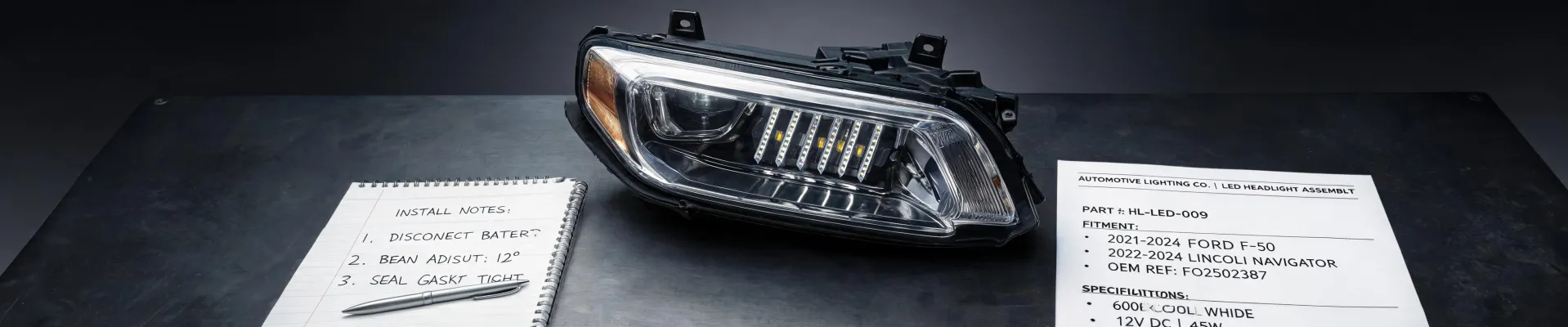
Tacoma Morimoto Headlights
The third-gen Tacoma (2016–2023) is a different story with a similar ending. The stock headlights are a known weak point in the Tacoma community—patchy beam patterns, short throw, mediocre output. We installed Tacoma Morimoto headlights on three of our Tacomas. Maybe four, I'd have to check the maintenance log.
The comparison wasn't subtle. The OEM beam had dark spots and a noticeably shorter reach. The Morimoto pattern was clean and even, with a sharp cutoff that didn't scatter light into oncoming traffic. Two of our drivers—who never comment on anything—mentioned the difference on their own. That convinced me more than any spec sheet. Cost difference was about $250 per vehicle over stock. Worth it for trucks that run early-morning routes.
That said, I should limit my scope: these were 2018–2020 Tacomas. The current generation might have better OEM lighting. Verify fitment for your specific model year before ordering.
2015 Chevy Cruze Alternator: Where OEM Earned Its Premium
We bought a batch of eight 2015 Chevy Cruze sedans in 2021. Good deal, decent fuel economy, reasonable maintenance. Then in late 2023, the alternator failed on one at 87,000 miles.
The dealer quoted $620 including labor. My regular aftermarket supplier offered a remanufactured unit at $280, installed. I ordered the aftermarket option. That's what the budget wanted.
The remanufactured alternator failed six weeks later. The warranty replacement failed again at four months. The car was down nine days total across both failures. Missed routes cost us more than the $340 price difference ever saved. That "cheap" alternator ended up costing roughly $850 in lost revenue and extra labor on top of the original quote. One of my best bad decisions.
When I pulled the invoice to review what had gone wrong, I saw the real issue: I had bought the cheapest remanufactured option, not a comparable product. This wasn't a case of aftermarket being inferior by design—it was a poor rebuild of a specific part. But for a 2015 Chevy Cruze alternator replacement, I now spec OEM without a second thought. The premium is reliability insurance for the component that keeps a car running.
Toyota Camry Strut Replacement: The Compromise I Won't Repeat
Fourteen of our fleet vehicles are Toyota Camrys, mostly 2018–2020 models. They're the workhorses. Strut replacement is scheduled proactively around 60,000–70,000 miles because ride quality starts degrading there. It's routine maintenance. Not urgent. No drama. Which made it a safe category to test aftermarket parts.
OEM struts run about $210 per strut. A mid-range aftermarket brand came in at $95. Same labor cost. I split the fleet: half got OEM, half got aftermarket.
For the first six months, I couldn't tell the difference. By month eight, the aftermarket-equipped Camrys had developed a floaty ride, especially on uneven roads. The OEM units were still tight past 90,000 miles. Not ideal, but workable—that's how I'd summarize the aftermarket struts.
To be fair, I only tested the mid-range tier, not premium aftermarket brands. The premium stuff might match OEM. But with fourteen vehicles, I'm not gambling the fleet on a maybe. For a Toyota Camry strut replacement, I'm back to OEM.
What's a Differential on a Car? And Where I Draw the Line
Let's answer a question I hear all the time from new drivers and non-car people: what's the differential on a car? It's not a car insurance deductible, and it's not "something differential." The differential is the gearbox component that lets your wheels spin at different speeds during a turn. When you go around a corner, the outside wheel travels a longer distance than the inside wheel. The differential allows those wheels to rotate at different rates while still getting power from the engine. No differential, no smooth cornering—the wheels would bind, tires would scrub, and the drivetrain would eventually break.
This is also the category where I stop comparing OEM vs aftermarket on my own. Drivetrain work isn't my area. When a differential issue comes up in our fleet—which is rare, maybe four times in six years—I call a specialist who works on axles and gearboxes. I don't pretend to understand gear ratios and shim stacks well enough to make that call for a twenty-two-vehicle fleet.
That boundary came from a specific experience in our 2024 vendor consolidation project. One supplier told me straight: "This isn't our strength. Here's who does it better." That honesty earned them my business in every category they do well. A vendor who admits a limitation is more credible than the one who says yes to everything.
Choosing OEM vs Aftermarket: My Actual Framework
After five years and hundreds of orders, here's the practical framework I've landed on:
Choose OEM when:
- It's an electrical component—alternators, starters, control modules. The 2015 Chevy Cruze alternator experience settled that argument permanently.
- It's load-bearing suspension. The Toyota Camry strut replacement experiment confirmed that a $115-per-strut saving wasn't worth the degraded ride at 80,000 miles.
- Vehicle downtime is more expensive than the part premium, which is true for every revenue-generating vehicle.
Choose aftermarket when:
- The brand has proven credibility in that specific category. Morimoto is a textbook example—their Porsche 997 tail lights and Tacoma headlights outperformed OEM in our testing.
- Fitment documentation is specific to your exact year and trim, not a vague "universal" claim.
- The warranty terms are in writing, and the supplier has a physical address and a working phone number.
Get a specialist before comparing when:
- It's a drivetrain component—differential, transmission, transfer case.
- The part is safety-critical and you're not certain about the spec.
- The vehicle is out of warranty and the repair involves multiple interacting parts.
Not every decision I've made was right. The Cruze alternator alone wrecked my quarterly budget variance. But the pattern is consistent now: the part category dictates the sourcing decision, not the vendor's marketing language.
This was accurate as of January 2025. Parts pricing and availability change fast—verify current rates, fitment, and supplier reputation before you order.