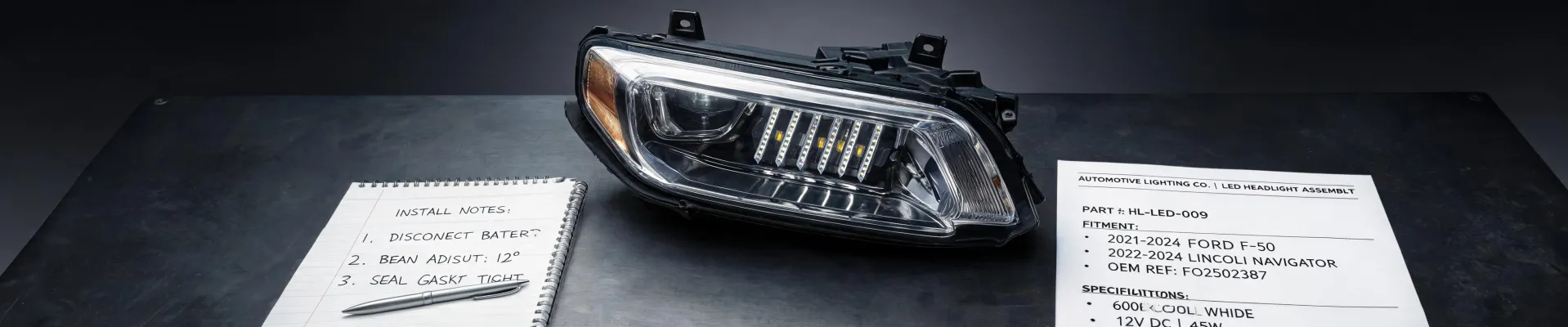
There's a question that shows up in my inbox a lot: "Should I just fix the part, replace it, or upgrade to something like Morimoto Tacoma tail lights?" It usually comes packed with another question: "And while I'm at it, is this car muffler noise actually the muffler?"
I work in quality at Morimoto, an automotive parts manufacturer. I review lighting and accessory products before they're cleared to ship—roughly 200 unique models a year. I've rejected first samples that didn't meet our beam pattern or finish requirements. I'm not a mechanic, and I can't diagnose your truck from a photo. What I can do is help you sort the decision into one of three buckets, because the right answer changes depending on whether you're fixing a failure, improving a working part, or guessing at a hidden problem.
Start with the category, not the part number
Before you search for a "car muffler" or browse tail lights, be honest about what's happening. A low beam headlight that's dead could be a bulb, a fuse, a relay, a worn socket, or a failing ballast. A rumbling exhaust could be a rusted muffler, a cracked pipe, or a catalytic converter coming apart. If you skip diagnosis, you might buy the right part for the wrong problem.
So here's the fork in the road: Is the part actually failing, is it working but disappointing you, or are you still not sure what's wrong?
Scenario 1: The part is dead, and it affects safety or legality
If your low beam headlight is out, that's not a cosmetic issue. It's a safety and legal issue. The fix should come before any performance upgrade. In the US, headlights are governed by Federal Motor Vehicle Safety Standard (FMVSS) 108, and a missing low beam is an obvious violation (Source: NHTSA, nhtsa.gov). Start by replacing the bulb, checking fuses, and making sure the connector isn't melted. If the replacement bulb does nothing, you may need the whole assembly.
The same logic applies to a catalytic converter. How do you know when your catalytic converter is bad? The common warning list includes:
- Check engine light—frequently a P0420 catalyst efficiency code
- Rattling noise from underneath, especially when cold
- Rotten-egg or sulfur smell from the exhaust
- Worse fuel economy than usual
- Failed emissions test or noticeably weak acceleration
If that list matches, don't just buy a car muffler and hope the noise stops. A rattling catalytic converter is not going to heal itself. A muffler replacement won't stop internal honeycomb material from breaking apart. You need a proper diagnostic before ordering parts.
On the topic of cost, a universal catalytic converter might look like a deal, but read the fine print. For a street-legal replacement in most of the US, the converter should be EPA-compliant and, in California, have a CARB Executive Order (verify current regulations at epa.gov before buying). A $200 universal part is only a deal if it's certified for your vehicle and installs without other issues. The cheaper route can turn into a $900 redo and a failed smog check. For most modern trucks and sedans, the part alone can land somewhere in the $400–$1,500 range (based on listed aftermarket prices as of January 2025; verify current rates).
Scenario 2: The part works, but you want it to work better
This is where aftermarket upgrades earn their place. If your low beam headlight works but you can't see far enough at night, swapping to a complete lighting package like Dodge Ram Morimoto headlights is more than a style move. It's a function move. You're not repairing a failure; you're buying better photometrics.
For Tacoma owners, Morimoto Tacoma tail lights are a popular upgrade because they replace the often-washed-out OEM signals with brighter LEDs and clearer optics. If your existing tail lights work fine but you want better visibility and a modern look, this is a legitimate upgrade scenario.
My only advice is to keep the quality standard in mind. Good aftermarket lighting should have a sharp, controlled beam cutoff. If you see a light kit advertised as "plug-and-play" but it's nothing more than a bulb dropped into a halogen reflector, skip it. In Q1 2024, I reviewed four low-cost LED bulb kits that claimed to be plug-and-play. Three had beam patterns that were not appropriate for standard reflector housings—lots of foreground light, weak down-road distance, and potential glare. We didn't ship them. The label "LED-compatible" doesn't mean optically correct.
Before you upgrade, check three things: fitment for your exact trim, whether the product is compliant with FMVSS 108 / SAE standards for signal lighting, and what the harness looks like. "Fits 2024 Tacoma" is not enough. "Fits TRD Off-Road without adaptive headlights" is better.
Scenario 3: You're not sure what's wrong, and you're about to guess
This is the category that gets expensive. Someone has a loud muffler, so they buy a performance muffler. The car is still loud after the install, because the real issue was a leak upstream. Another driver has a dim low beam, so they buy brighter bulbs, but the real issue is a corroded ground or a failing alternator. The part wasn't the problem; the diagnostic was.
I have mixed feelings about universal catalytic converters in this scenario. On one hand, they can be a practical fix for an older car. On the other hand, if the P0420 code is caused by an exhaust leak or a bad oxygen sensor, swapping the converter is a waste of money until the real cause is confirmed. The same "don't guess" rule applies to low beams: if the new bulb fails again in two weeks, something is eating bulbs—wiring, vibration, or a bad socket. Upgrading to Morimoto headlights on a car with a voltage problem is not a smart use of good parts.
How do you know when your catalytic converter is bad and not just misdiagnosed? You don't, until you check the live data. A scan tool showing catalyst efficiency below threshold, combined with fuel trims that don't look crazy, points toward the converter. High fuel trims and a small vacuum leak suggest something else. That's why a decent mechanic's diagnostic fee is worth paying. It's cheaper than a wrong part.
One personal tick: I once bought a $15 universal tail light bulb because the proper bulb was $34. I thought I was being smart. Six months later, the bulb's coating burned and left a dark spot. I replaced it with the correct part—plus the same labor. Saved $19, spent $70 more. The saving didn't end up saving anything.
How to tell which scenario you're in
Here's the practical filter I use, and I think it works for anything from a low beam headlight to a muffler to a complete lighting kit:
- Is the car currently illegal, unsafe, or failing an inspection to drive? If yes, you're in scenario 1. Fix the broken thing first.
- Does the part technically work but underperform? If yes, you're in scenario 2, and it's okay to consider an upgrade—as long as the vehicle's electrical and exhaust systems are healthy.
- Are you still guessing at the diagnosis? Then stop. Get a proper scan/test, confirm the root cause, and then decide. Guessing is the most expensive path.
For lighting specifically, if you've owned the vehicle for a while and you know you want to keep it, a quality LED upgrade—whether it's Morimoto Tacoma tail lights or a Dodge Ram Morimoto headlight conversion—can be a better investment than a third set of OEM halogen bulbs. But if the reason you're looking is a check engine light and a weird noise, fix that first.
I don't think there's a universal right answer. I do think there's a universal right sequence: diagnose first, then decide whether to repair or upgrade. Or, as I tell people, don't let the parts catalog write the shop order.