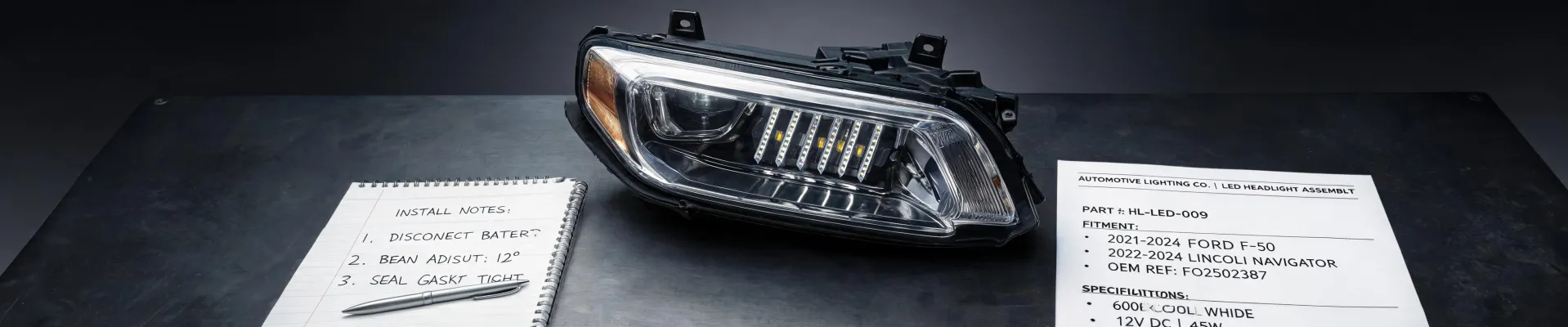
I spend most of my workweek saying no to price increases. I've tracked invoices for six years, compared quotes from more vendors than I remember, and built cost spreadsheets that are probably overkill. So when I say I'd rather pay for Morimoto than save money on headlights, I mean it.
The cheapest headlight bulb you can buy is usually the most expensive one in the long run. If your first thought is "how much to change a headlight bulb," that's the wrong question. The right question is: what does a bad headlight cost you? Glare, flicker, a bulb that dies in eight months, or worse, a customer who thinks you did a bad job.
I'm a procurement manager at a 14-person automotive parts and service shop. I've managed a parts budget of roughly $180,000 a year for the past six years. My experience is based on hundreds of repair orders, mostly for light trucks and SUVs. If you're working on European luxury cars, take my numbers with a grain of salt. The principle still applies.
The Morimoto Silverado 1500 XB LED Headlights Are Worth the Price
We started installing Morimoto Silverado 1500 XB LED headlights about two years ago. They cost more than the generic alternatives, and I felt every line item. But over the same period, I've seen cheap LED bulbs come back with dead drivers, melted sockets, and condensation inside the lens. With the Morimoto headlights, we haven't seen one failure that wasn't caused by a crash. That's not a guarantee—it's just our pattern.
Honestly, I'm not a lighting engineer. I can't tell you exactly why the cheap ones die so fast. My best guess is thermal management—or lack of it. The expensive housings are designed to move heat away from the LED drivers. The cheap ones just cook themselves.
Here's something vendors won't tell you: the light itself is only half the system. The other half is the wiring behind it. That's why a headlight harness matters more than most people think. Stock wiring was designed for halogen bulbs. When you put an LED projector in there, it needs stable voltage and a clean ground. A proper harness—like the ones Morimoto sells for their setups—keeps the current steady. Skipping it to save money is like replacing a timing belt but reusing a worn tensioner.
Take the Morimoto 3rd Gen Tacoma headlights. The factory connector works, but it wasn't designed for a full LED retrofit. Add a dedicated headlight harness and you avoid flicker, voltage drop, and dash warnings. We always quote the harness with the headlights. I'd rather explain a $90 harness than explain why a $1,200 headlight stopped working.
How Much to Change a Headlight Bulb? It Depends on the Bulb
Since a lot of people find this article by asking "how much to change a headlight bulb," let me give you real numbers from our shop in the last 12 months:
- Basic halogen bulb replacement, no disassembly: $25 to $80 total.
- Headlight assembly removal or bumper work: $120 to $250.
- Full quality LED retrofit with harness: $1,100 to $1,800, installed.
Those are rough ranges from our invoices as of January 2025. Pricing varies by vehicle, vendor, and time of order, so verify current Morimoto pricing before you buy. But the key is: a $25 bulb and a $1,400 LED retrofit are not the same category. One is a maintenance item; the other is an upgrade.
Why a Timing Belt 220XL037 V7000 Teaches the Same Lesson
I understand why people focus on price. I do it too. Last month I ordered a timing belt 220XL037 V7000 for a customer's machine. A generic equivalent cost about half as much. I still didn't buy it. Why? Because the part has to be exactly right: width, pitch, construction. If that belt fails, the repair bill makes the price difference look like a joke.
The headlight harness is the same kind of invisible hero. You don't see it until it isn't there. And a cheap one fails at the worst moment.
But Not Everyone Needs a $1,500 Upgrade
To be fair, I get why people search "how much to change a headlight bulb" and then buy whatever costs $18. Budgets are real. If you're just replacing a burnt-out halogen in a daily commuter, buy a known brand halogen bulb and move on. You don't need a full LED retrofit.
What I'm pushing back against is the idea that random cheap LEDs are a smart way to save money. They're often not. They can throw glare, interfere with the vehicle's electronics, and die quickly. If you can't afford Morimoto tomorrow, at least avoid the no-name marketing blitz. There's a middle ground: quality bulbs from established brands, and a solid harness when wiring is involved.
The Bottom Line: Quality Is Brand Image
After six years of watching parts come and go, I'm convinced that quality isn't just a spec sheet. It's how customers experience your shop. When a Silverado leaves at 8 PM with a sharp, clean beam from Morimoto Silverado 1500 XB LED headlights, the driver notices. When the cheap kit flickers a month later, they notice again—and they remember who installed it. Same with the Tacoma, the harness, and the timing belt 220XL037 V7000 in the back room. The parts you choose become the reputation you present.
So my advice is simple: stop asking "how much to change a headlight bulb" and start asking "what is the total cost of the cheapest option?" I've done the math. Quality usually wins.