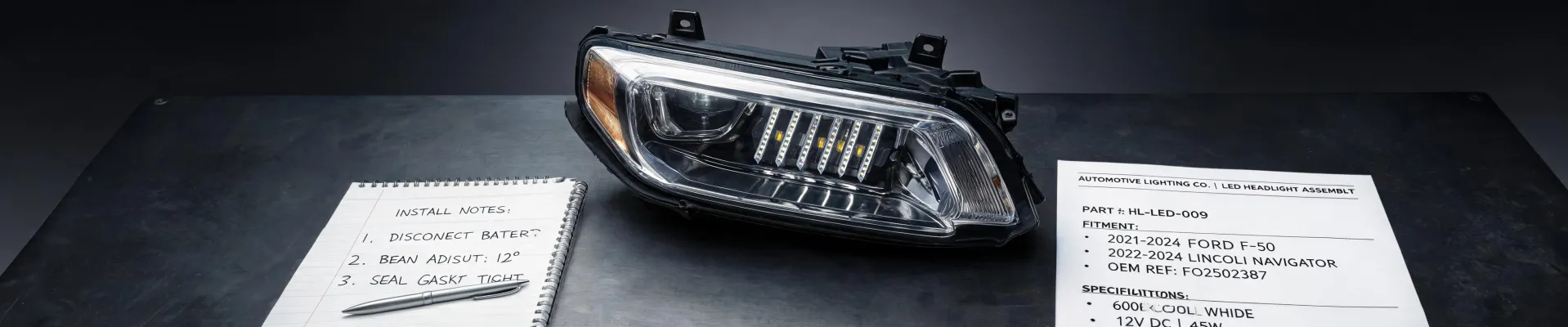
The Call That Started It All
The call came in at 2:47 PM on a Tuesday. A fleet manager in Phoenix had a RAM 2500 with a burned-out headlight housing, and the truck absolutely had to pass a DOT inspection by Thursday morning. Not "preferably." Not "it'd be nice." The inspection was the gatekeeper for a six-figure delivery contract, and without headlights, the truck wasn't moving.
His first instinct was to grab the cheapest replacement he could find locally. I get it. A headlight is a headlight, right? But when you're cracking the front end of a truck open anyway, the last thing you want is to bolt in a part you'll be replacing again in 18 months. I walked him through the math of going with Morimoto headlights for the RAM 2500 instead. Better beam pattern, real durability, and a brand that doesn't cut corners on the details that matter. He said "send them." That's when the clock started.
And of course, this wasn't my only problem that day.
One Afternoon, Four Problems
The warehouse manager was standing at my desk holding a spark plug box with the wrong part number printed on the label. We had already shipped twelve of those boxes to a local repair shop. The shop hadn't noticed yet. But it was only a matter of time — and we both knew what "later" means when a customer finds a mislabeled box on their shelf.
Then the service department dropped another one on my plate. A BMW 330i exhaust system had arrived with a dented muffler just hours before a client's weekend install. The distributor was 400 miles away and closed on Saturdays. Our client was not going to be happy. Neither were we.
Oh, and my service truck was leaking coolant. A look under the hood confirmed the bad news: cracked radiator. People ask me what causes a cracked radiator all the time. Usually it's one of three things: thermal stress, road debris impact, or old coolant that turned corrosive. In our case, it was thermal stress. The thermostat stuck closed, the pressure spiked, and the cooling system vented itself into the parking lot in a very permanent way. The truck needed a new radiator that night or every delivery scheduled for tomorrow morning was dead in the water.
So, in one afternoon, I was managing:
- A set of Morimoto sequential turn signals and headlights for a RAM 2500 that had to ship within hours
- A spark plug box labeling error that could cost us a long-time customer
- A BMW 330i exhaust system replacement that required a 400-mile courier run
- A cracked radiator in our own service truck
This is where the quality lesson starts. Because every single one of those problems had a cheap fix. And every single one of those cheap fixes would have cost us more in the long run.
Let me walk you through the decision on the RAM 2500 headlights, because it's the one that stuck with me.
The spreadsheet said: buy the cheapest available headlight, ship it ground, hope it gets there Wednesday. The logic was sound. It was a DOT inspection, not a car show. And a lower invoice would have meant happier margins.
My gut said otherwise. The numbers said economy. My gut said quality. What I mean is: when a customer pulls a product out of a box in front of an inspector, the quality they see is the quality they'll associate with your company. That $80 difference between a budget housing and the Morimoto headlights? It's nothing compared to the value of the truck being on the road, the contract being signed, and that customer telling three other fleet managers exactly where they got their parts.
Every cost analysis pointed to the budget option. But something felt off about going cheap on a part that sits 24 inches in front of the driver for the next five years. I've made that mistake before. I wasn't making it again.
So we shipped the Morimoto headlights and sequential turn signals with the correct harness adapter, included the torque specs, and paid an extra $78 in expedited shipping — on top of the $1,140 in parts — to land it by Wednesday afternoon. The finance side of my brain twitched. But the part of me that knows this industry said: watch what happens next.
What happened next was the customer calling Wednesday evening. Not to complain. To tell us they'd never seen a box that complete. Adapter labeled. Instructions clear. Zip ties separated. That's not an accident — Morimoto puts that level of care into their packaging, and it shows the second the box hits the loading dock. That call turned into a reorder for three more trucks. This is what quality does. It compounds.
We handled the spark plug box problem the same way. We called the repair shop that afternoon and told them exactly what happened. No spin. No half-apology. We re-labeled every box at our own cost and hand-delivered the corrected ones. Cost us about $140 in labor and fuel. The shop owner's reply? "If you'd tried to hide it, you'd have lost us. Instead, you've got us for the next two years."
We could have mailed the corrected labels through USPS — First-Class postage is $0.73 per ounce as of January 2025, and the labels weighed next to nothing. But putting a stamp on a mistake doesn't fix the relationship. Hand-delivering did.
The BMW 330i exhaust system was harder. The distributor had the part but no driver until Monday. So we paid a courier $200 to make the 400-mile run overnight. The box landed Saturday at 6 AM. The client's install went off without a hitch. The event wasn't ruined. And that $200 courier fee? Less expensive than the $12,000 project the client would have lost.
And the radiator on our service truck? We had it replaced that same night. $380 for the part plus labor. No negotiation. Because the truck that shows up at our customers' doors is part of our brand too. We weren't going to send out a vehicle that drips coolant onto a customer's driveway.
What That Week Taught Me About Quality
So what did I actually learn from that week? Let me lay it out.
Quality is the entire experience, not just the product. The Morimoto headlights are genuinely impressive. But so are the packaging, the instructions, the harness, the follow-up call. Every touchpoint counts.
Rush orders don't justify cutting corners. Actually, it's the opposite. When you're under a deadline, every aspect of the experience is amplified. If a part arrives late, it's not a "minor delay" — it's a crisis. When you deliver quality in a crisis, you create a story the customer tells other people.
Cheap is expensive. That budget headlight would have saved $80 and delivered a dimmer, weaker beam pattern. It would likely need replacing in two years. The Morimoto setup fixed the actual root cause of the problem — factory lighting that had been marginal from day one.
Why does this matter for your business? Because your customers form an opinion of you at every step. The accuracy of the label on a spark plug box. The way a BMW 330i exhaust system shows up. The answer you give when somebody asks what causes a cracked radiator. All of it feeds into one thing: trust.
And trust follows the product. Per FTC guidelines on advertising, we don't make performance claims without evidence. We've got the test data. But the best proof is the product out on the road, month after month.
Take it from someone who's spent eight years triaging rush orders for an automotive parts company — maybe 200 of them, maybe 180, I'd have to check the system. The ones that went right weren't the ones where we found the cheapest option. They were the ones where we asked: what does this customer actually need to succeed?
One caveat: this approach worked for us because we're a mid-sized operation with supplier relationships built over a decade. If you're a smaller shop, you may not be able to absorb a $200 courier fee or a $140 re-labeling run. I understand that. The principle still holds, though — find the point where quality matters most to your customer, and put your resources there.
The bottom line? If you need Morimoto headlights for a RAM 2500, give us a call. We'll get you sorted. And it'll be done right.